
BJJ vs Judo: Two Grappling Arts, Honestly Compared

If you are choosing a grappling art in India, you have probably typed "BJJ vs Judo" into a search bar and found a lot of heat and not much honesty. Here is a plain comparison from someone who teaches one of them for a living. Both are good. They are cousins, not rivals, and knowing how they differ helps you choose the room you will actually enjoy walking into.
BJJ vs Judo: a shared family tree
Any honest BJJ vs Judo comparison has to start with the fact that they come from the same house. Both descend from Japanese jujutsu, the old battlefield grappling of the samurai. In the late 1800s, Jigoro Kano took those techniques, removed the most dangerous ones, and organised what remained into a teaching method he called Judo. His idea was that you could train grappling hard and safely if you built the syllabus around throws and controls that a partner could survive being on the receiving end of, thousands of times.
Brazilian Jiu-Jitsu grew out of that work. In the early twentieth century, one of Kano's students, Mitsuyo Maeda, travelled and taught abroad, and in Brazil his students developed the ground-fighting side of the art into a system of its own. So when people frame BJJ vs Judo as two opposing camps, they are really looking at one family that branched. That shared root is why so much vocabulary carries across: the gi, the belt ranks, the emphasis on leverage over strength, the bow before you step on the mat.
The core difference in BJJ vs Judo: where the fight lives
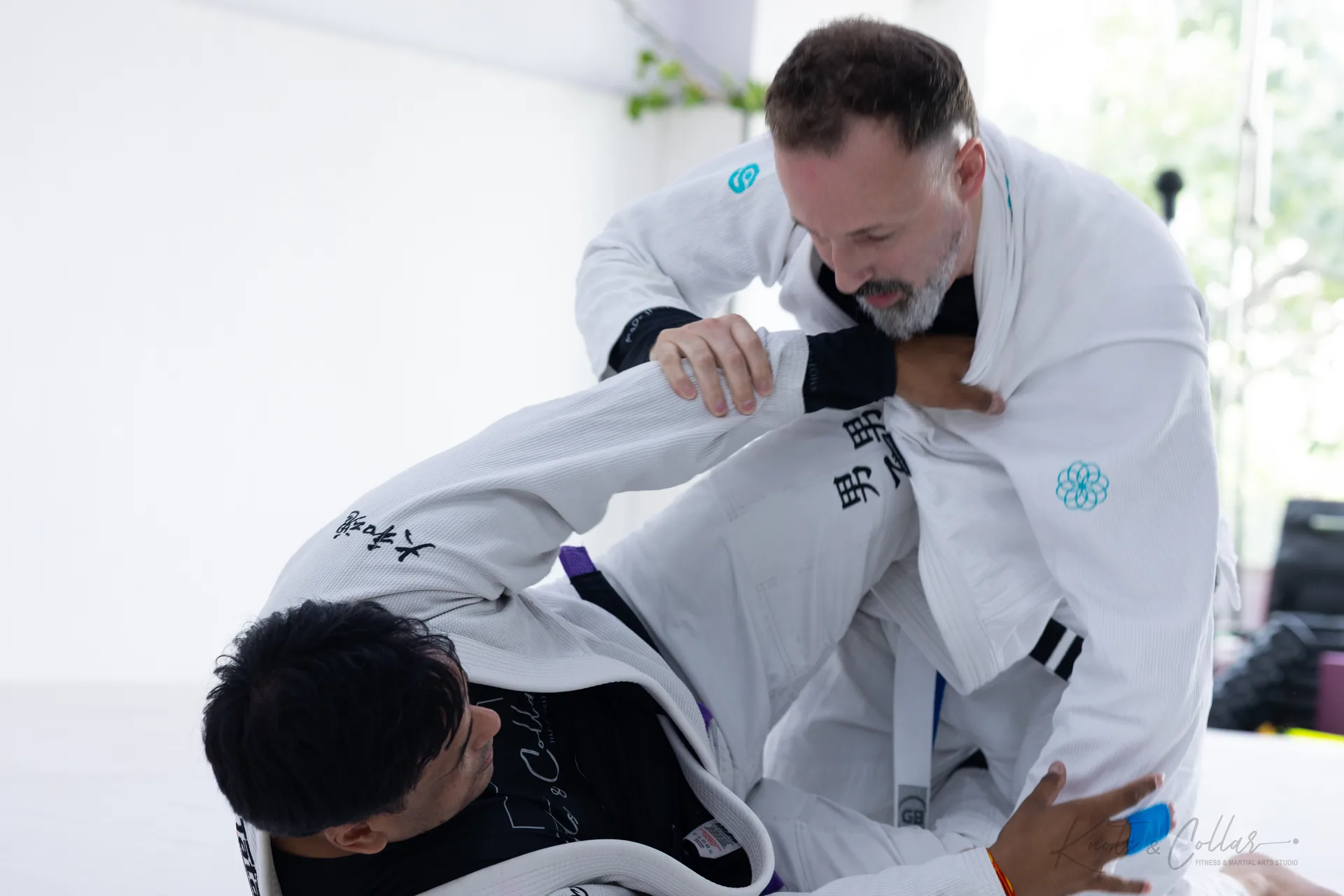
If you strip everything else away, the difference between BJJ and Judo is where each art wants the fight to happen. Judo lives standing. Its heart is the throw: gripping your partner's gi, breaking their balance, and putting them cleanly on their back. A strong throw can end a Judo match on its own. There is groundwork in Judo too, but the standing exchange is the centre of gravity.
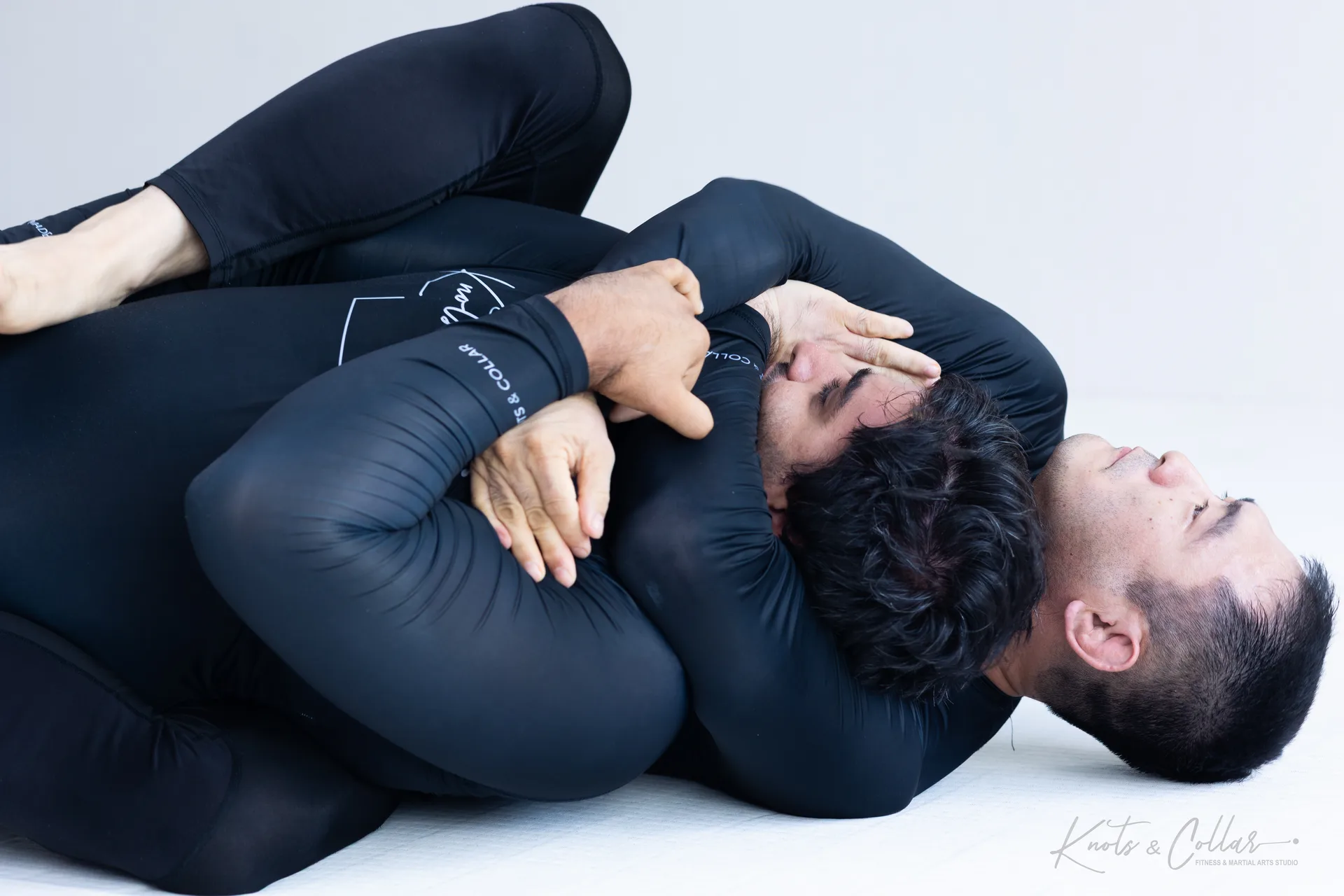
BJJ lives on the ground. A throw or a takedown is how you get there, but the art really begins once both people are down. From there, BJJ is about positional control, working through a hierarchy of positions, and finishing with a submission, a joint lock or a choke that gives your partner the chance to tap and reset. In BJJ, being on your back is not losing; the guard, a position played from underneath, is one of the art's deepest chapters. That single idea, that the bottom position can be an offensive one, is the clearest fault line in the whole BJJ vs Judo question.
Rulesets and scoring, at a high level
You can feel the difference in how each art is scored. In Judo, the prized outcome is ippon, a single decisive result won by a clean throw, a hold-down of sufficient length, or a submission. Score ippon and the match is over. This rewards commitment and timing: everything builds toward one clean, full-power moment done under control.
BJJ competition scores the slower story of the ground. Points accumulate as you advance through positions, passing the guard, taking mount, taking the back, and a submission ends the match outright at any moment. Because the reward structure favours control and the finish, BJJ matches tend to unfold as a patient chess game rather than a single explosive throw. Neither scoring system is more correct. Each simply protects what its art values, and the rules are also written so that people can train them full-out, year after year, without wearing their bodies down.

What each art builds in you
Physically, the two arts shape different bodies and reflexes. Judo builds explosive power, grip strength, and an unusually good sense of balance, both keeping your own and taking someone else's. Learning to be thrown, and to fall safely, teaches your body a kind of composure that carries into ordinary life; the breakfall is a genuinely useful skill to own. BJJ builds core control, flexibility, and a slow-burning endurance, the ability to stay calm and keep problem-solving while someone is trying to control you.
Mentally, both arts teach the same core lesson from different angles: you cannot fake your way through live grappling. In Judo, you learn decisiveness and the courage to commit to a throw. In BJJ, you learn patience and the discipline to work one small step at a time. Both teach you to stay level-headed under pressure, and both hand you the same humbling gift, the tap, which lets you fail safely and often and treat each failure as information rather than defeat. That is the spirit we mean at Knots & Collar when we talk about Kindness Over Toughness: the point is to help each other improve, not to prove anything.
Can you cross-train BJJ and Judo?
Yes, and they fit together naturally. This is where the BJJ vs Judo framing finally breaks down, because in practice the two fill each other's gaps. A common, honest weakness in BJJ is getting the fight to the ground in the first place; that is precisely what Judo trains. A common gap in Judo is what to do once the action stalls on the mat; that is precisely BJJ's home ground. A judoka who adds guard work and submissions becomes far harder to deal with once the throw lands. A BJJ player who adds real throws gains a reliable way to dictate where the match goes.
Plenty of grapplers train both over a career, and time on either mat makes you better on the other. If you have wondered how BJJ sits alongside the striking arts too, our piece on BJJ vs MMA and which to train works through that in the same spirit.
Which should a beginner in India start with?
Here is the honest, non-partisan answer. For most beginners in India, the single biggest factor is not the art, it is access. The right first grappling art is the one with a qualified instructor and a welcoming room near enough that you will actually turn up three times a week for a year. Consistency beats the style printed on the door. Judo has deep roots in India and long-established clubs; BJJ is newer here but growing quickly, especially in the cities.
If both are genuinely available to you, choose by what pulls at you. If the idea of throws, standing exchanges, and explosive timing excites you, Judo is a wonderful place to start. If you are drawn to ground control, submissions, and the puzzle-solving patience of the guard, BJJ will suit you. Either way, the deciding factor should be the teaching and the people, not a winner declared in an internet argument. If you want a framework for judging a room before you commit, our guide on how to choose a BJJ academy in India applies just as well to a Judo dojo.
I teach BJJ, under the De La Riva lineage, so I will not pretend to be neutral about how much I love the art. But I will not tell you it is better than Judo, because that would not be true or useful. They are two good answers to the same old question of how to control another person safely. If you are leaning toward the ground game, you might also read our honest take on what BJJ really offers for self-defence, and our beginner's look at Gi vs No-Gi BJJ once you have decided to give jiu-jitsu a try.
The best way to settle a BJJ vs Judo debate is to feel it for yourself. If you are in or near Defence Colony, New Delhi, you are welcome to come watch a class, ask questions, and see whether the room feels right. No pressure, no sales pitch. Schedule a visit and we will show you around.
FAQs
Is BJJ the same as Judo?
No, though they are close relatives. Both descend from Japanese jujutsu, and Brazilian Jiu-Jitsu grew directly out of Judo. The difference is emphasis: Judo centres on throws and standing grappling, while BJJ centres on ground control and submissions. They share a language but speak it differently.
Which is better, BJJ or Judo?
Neither is better in a general sense. They train different skills and reward different strengths. Judo develops throwing, balance, and standing control; BJJ develops ground positioning and submissions. The right choice depends on what you want to learn, not on one art outranking the other.
Can you cross-train BJJ and Judo?
Yes, and the two complement each other well. Judo gives a BJJ practitioner a way to take the fight to the ground; BJJ gives a judoka a deeper ground game once the throw is finished. Many grapplers train both over time.
Should a beginner in India start with BJJ or Judo?
Start with whichever art has a qualified instructor and a welcoming room near you, because consistency matters more than the style on the sign. If both are available, choose based on what draws you: throws and standing work point to Judo, ground control and submissions point to BJJ.