
Rolling Smart: How to Train BJJ Without Getting Injured
Brazilian Jiu-Jitsu is one of the few contact sports you can practise close to full effort, several times a week, for decades. That is only true if you train it well. The people who get hurt are rarely the ones who lack talent — they are the ones in a hurry. This is a plain guide to how to train BJJ without getting injured, written for beginners and returning grapplers at Knots & Collar in Defence Colony, New Delhi. It is general information, not medical advice: for any real injury, see a doctor or physiotherapist.
The common BJJ injuries, in plain terms
Most BJJ injuries fall into a short, predictable list, and understanding them takes the mystery out of staying healthy. Fingers come first. Beginners tend to grip the gi with everything they have, and the small joints in the hand take the strain over time. Ease your grip, use your whole body instead of clamping down, and give sore fingers a rest before they become a nagging problem.
Knees are next. The knee does not like being twisted while it is bearing weight, which is exactly what happens when a leg gets tangled and you spin or scramble anyway. Learn to recognise when your leg is trapped and to move with it rather than against it. Neck and ribs round out the list. Both usually get sore for the same reason: someone stayed in a bad position and resisted with force instead of tapping or resetting. None of this is meant to alarm you. The great majority of these BJJ injuries are minor, and nearly all of them are avoidable with the habits below.
Tap early, tap often — ego is the real risk
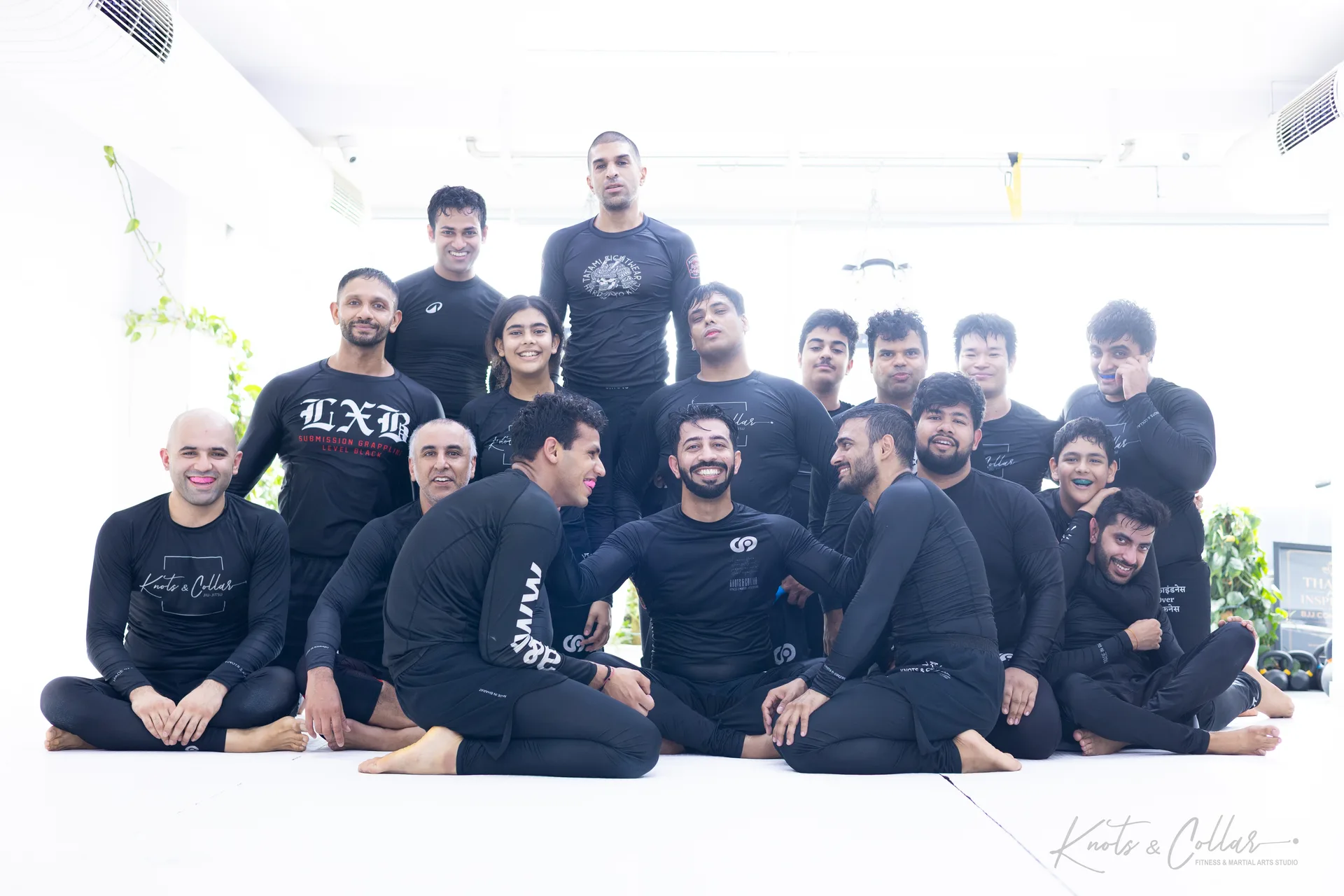
If there is one habit that protects you more than any other, it is tapping in time. A submission is a question, and the tap is simply your answer: not today. Tapping early costs you nothing. You reset, you learn what caught you, and you go again thirty seconds later. Refusing to tap because a submission is "not fully on yet," or because you do not want to lose to a lower belt, is how a joint gets tweaked and a good training week turns into a month off the mat.
The real risk in this sport is almost never your partner. It is ego — yours. The strongest, most experienced grapplers we know tap constantly in training, precisely because they intend to keep training for another twenty years. Treat the tap as information, not defeat. A caught arm is a lesson delivered for free. A torn one is a lesson delivered with interest.
Communicating with partners and choosing your rounds
Jiu-Jitsu is a conversation, and the conversation starts before the round does. Tell your partner if you are carrying a stiff shoulder, a bad knee, or a finger you are protecting. Nobody thinks less of you for it, and everyone rolls a little more carefully when they know. A quick word — "go easy on my left knee today" — takes two seconds and prevents most avoidable mishaps.
You are also allowed to choose your rounds. You do not have to accept every hard roll from every partner every session. If someone is spinning up faster and rougher than you want to match, sit one out, drill instead, or pick a calmer partner. Good training partners read each other's pace and meet in the middle. If a roll starts feeling like a fight rather than a puzzle, slow it down out loud or reset. Managing intensity together is a skill, and it is one of the clearest ways to train BJJ without getting injured.
Warm up and build tissue tolerance
Cold joints and stiff muscles do not respond well to sudden load, and BJJ asks a lot of your hips, spine, neck, and shoulders. Arrive a few minutes early and move before you roll: gentle neck circles, hip openers, some light movement to raise your heart rate, and a few reps of the shrimps and bridges that show up in almost every class anyway. The warm-up is not a formality. It is the difference between tissue that gives and tissue that tears.
Beyond the daily warm-up, tissue tolerance is built over months, not in a single session. Your tendons and ligaments adapt more slowly than your enthusiasm does, which is why the most common beginner mistake is training too hard, too often, too soon. Add sessions gradually. Let your body catch up to your motivation. Consistency over years beats intensity over weeks, and it is far kinder to your joints.

Leave the spazzy intensity out — Kindness Over Toughness in practice
Kindness Over Toughness is our name for the way we train, and injury prevention is where it stops being a slogan and becomes a method. A relaxed, controlled roll is a safe roll — for you and for your partner. The person who explodes through every position with maximum force, eyes closed, arms flailing, is not tougher. They are simply harder to train with and more likely to hurt someone, usually by accident.
Control is the goal, not domination. When you slow down, you feel more, you learn faster, and you give your partner room to work too. Newer students sometimes think intensity is what makes it real Jiu-Jitsu. It is the opposite. The calmer you can stay while someone tries to pass your guard, the better your Jiu-Jitsu is becoming. If you want more on the thinking behind this, read our piece on the Kindness Over Toughness philosophy and on the etiquette, hygiene, and discipline that keep the mat safe for everyone.
Training around your age and old injuries
Not everyone who walks onto the mat is a twenty-year-old with no history. Many of our students start later, carry old injuries from other sports, or simply need to be thoughtful about a specific joint. That is not a barrier to training — it is a reason to train smart. If you are coming to Jiu-Jitsu later in life, our guide to starting BJJ over 30 covers this in more depth.
The practical rules are the same, just applied with more care. Warm up longer. Tap earlier. Tell your coach and partners what you are protecting. Skip the rounds that do not serve you, and lean into drilling, which builds skill with almost none of the risk. Age and old injuries change how you train, not whether you can. Plenty of people are still on the mat in their fifties and sixties precisely because they respected their bodies along the way.
Recovery, sleep, and knowing when to rest
What you do off the mat decides how well your body holds up on it. Sleep is the single most useful recovery tool you have, and it is free. Muscles and connective tissue repair while you rest, so chronic short sleep leaves you training on tissue that never fully recovered from the last session. Drink enough water, eat enough, and give hard sessions the down time they need.
Above all, learn to listen to your body and tell the difference between soreness and pain. Ordinary muscle soreness fades in a day or two and is a normal part of getting fitter. Sharp pain, swelling, a joint that feels unstable, or an ache that lingers for weeks is a different signal — that is your body asking you to stop, rest, and get it looked at. A short, deliberate break to heal properly will always cost you less time than pushing through and turning a small problem into a long one. To keep progressing while you train sensibly, our notes on how to improve at BJJ faster lean on consistency rather than intensity, which is exactly what keeps you healthy too.
None of this is medical advice. It is the everyday wisdom of a mat, offered so you can train for the long haul. For anything that hurts in a way that worries you, please see a doctor or physiotherapist.
If you would like to see how we teach this in person — calm, controlled, beginner-friendly, and built around keeping people healthy — you are welcome to come and watch a class or roll with us. Schedule a visit whenever you are ready. There is no rush, and there never should be.
FAQs
Is Brazilian Jiu-Jitsu safe to train?
BJJ can be trained safely for years when you tap early, warm up properly, and roll with control. Most injuries come from ego and rushing, not from the art itself. At Knots & Collar we teach it as a skill first, so beginners learn to stay relaxed and protect themselves and their partners from day one.
What are the most common BJJ injuries?
The ones we see most often are to the fingers, knees, neck, and ribs. Almost all of them are minor and avoidable. Fingers get strained from over-gripping the gi, knees from twisting under load, and ribs and necks from resisting a position that is already lost. Tapping in time removes most of that risk.
How do I avoid injury as an older beginner starting BJJ?
Start slow, tell your partners about any old injuries before you roll, and choose your training rounds. You do not have to accept every hard roll. Warm up thoroughly, prioritise recovery and sleep, and let your body set the pace. Plenty of people begin in their 30s, 40s, and beyond and train comfortably for years.
Should I train BJJ while injured or in pain?
No. Sharp pain, swelling, or anything that lingers is a signal to rest and see a doctor or physiotherapist. This article is general information, not medical advice. A short break to heal properly will always cost you less time than pushing through and turning a small problem into a long one.