
Made in Bharat: The BJJ Gi We Build in India

When we set out to put a Knots & Collar gi on the mat, we had a simple choice: import a finished product with someone else's label sewn in, or learn to build one here at home. We chose to build. This is the story of our Made in Bharat BJJ gi — why we make it in India, what "thread to packaging" really means, and how to judge a good training gi honestly, whether you buy ours or someone else's.
Why we chose to make our gi in India
It would have been easier to import. Order a container of finished gis from overseas, put a tag on them, and sell. Plenty of that happens. But it never sat right with us. We train seven days a week in Defence Colony, New Delhi, and the people on our mats deserve a gi we can actually vouch for — one whose seams we have watched being stitched, whose cloth we have washed and rolled in ourselves before asking anyone to trust it.
Making a BJJ gi in India also means we can fix things. If a collar runs too stiff, or a cut sits wrong on Indian frames, we can walk to the people making it and change it. That short distance between the mat and the machine is the whole point. An imported gi is finished the day it leaves a factory we will never see. A gi made here keeps improving because we live next to the people who build it.

What "Made in Bharat, thread to packaging" means
The phrase is not a slogan for us — it is a checklist. Thread to packaging means every stage of the Indian BJJ gi happens on home soil: the cotton, the weaving of the jacket cloth, the cutting of panels, the stitching of collar and reinforcements, the finishing, and the box it ships in. When we say Made in Bharat, we mean the whole gi, not a final button sewn on at the end to earn a label.
We are careful with that claim because the martial arts world is full of vague ones. A "designed in" tag is not the same as a "made in" one. So we keep it plain: our BJJ gi is built in India, front to back, and the people who build it are paid to build it well. That is a quieter story than a fireworks launch, but it is a true one, and truth is the only thing worth selling a training partner.
What actually makes a good training gi
Before you buy any gi — ours or another maker's — it helps to know what you are looking at. Here is honest guidance, the same we give beginners in the changing room.
GSM and weave. GSM is grams per square metre — the weight of the jacket cloth. Lighter gis (around 350 GSM and under) feel airy and dry fast, but can wear thin faster and give opponents less to hold, which some people like and some do not. Heavier jackets (450 GSM and up) are tough and hard to grip but hot, slow to dry, and often overkill for daily class in a Delhi summer. The weave — single, pearl, gold — describes how the cloth is knitted; pearl weave is a common, sensible middle ground that balances weight and durability.
Fit. A gi should let you move without swimming in fabric. Sleeves and pant cuffs that are too long get grabbed and slow your escapes; too short and you may fail a competition measurement. Look at the shoulders and the taper of the jacket, not just the label size.
Durability and shrinkage. Cotton shrinks. Any honest gi maker will tell you a new cotton gi tightens on its first washes. What matters is that the shrinkage is small and predictable, and that the stress points — collar, armpit gussets, knee seams, belt loops — are reinforced so they survive being yanked on for years. Cheap gis fail at the seams first.
How a 380 GSM gi holds up to daily rolling
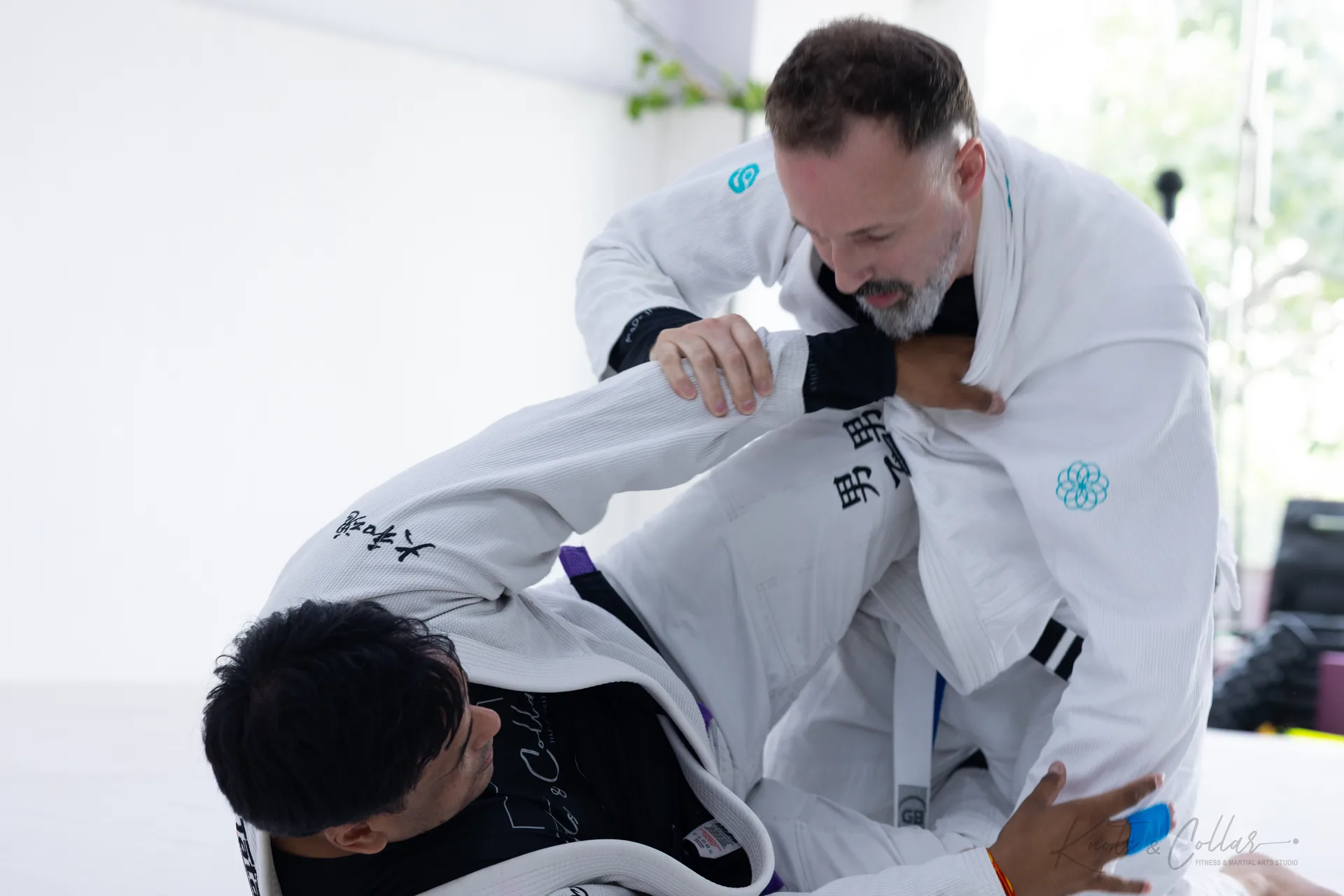
We settled on a 380 GSM gi on purpose. It is a mid-weight — sturdy enough to take the grip-fighting, the washing, and the general punishment of training several times a week, but not so heavy that it turns every summer class into a sauna. For someone rolling daily, that balance matters more than any single number on a spec sheet.
In practice, a well-built 380 GSM jacket gives your partner enough cloth to grip for real jiu-jitsu, dries in reasonable time between sessions, and keeps its shape wash after wash. The reinforced seams are what carry it through the years — a gi lives or dies at the points where it gets pulled hardest. We chose 380 because it is the weight we ourselves want to train in, day after day, not the weight that photographs heaviest.
If you are still weighing whether to train in a gi at all, our gi vs no-gi guide for beginners walks through what each style teaches and why most people in India start in the gi.
A growing Indian jiu-jitsu identity
Jiu-jitsu arrived in India from Brazil, and we honour that lineage openly — our coaching traces to the De La Riva school, and we say so with respect, not with a marketing flourish. But the sport here is no longer only borrowed. There are mats in more Indian cities every year, more Indian competitors, more kids growing up thinking of a gi as ordinary kit. A BJJ gi made in India is a small, concrete part of that growing identity: proof that the cloth, and not only the technique, can be ours.
We do not want to oversell this. Making a gi in India does not make anyone a better grappler — technique and mat time do that. What it does is let Indian practitioners train in something built at home, by people paid fairly, that they can be quietly proud of. If you want the wider picture of the sport here, we wrote a longer piece: BJJ in India, a complete guide.
Caring for your gi so it lasts
A good gi rewards a little care, and neglects nothing so quickly as a damp bag. The rules are simple. Wash it in cold water after every session — not because the gi is delicate, but because bacteria are not, and a clean gi is a courtesy to everyone you train with. Hang-dry it out of direct sun; skip the hot dryer, which is the fastest way to shrink and weaken cotton. Never leave a wet gi balled up overnight. Do not bleach it.
Do these few things and a 380 GSM gi will stay with you through years of training — softening, settling into your body, becoming the one you reach for. Hygiene is not a side note in jiu-jitsu; it is part of the etiquette of the mat, which we take seriously enough to have written about it in the foundations of etiquette, hygiene and discipline.
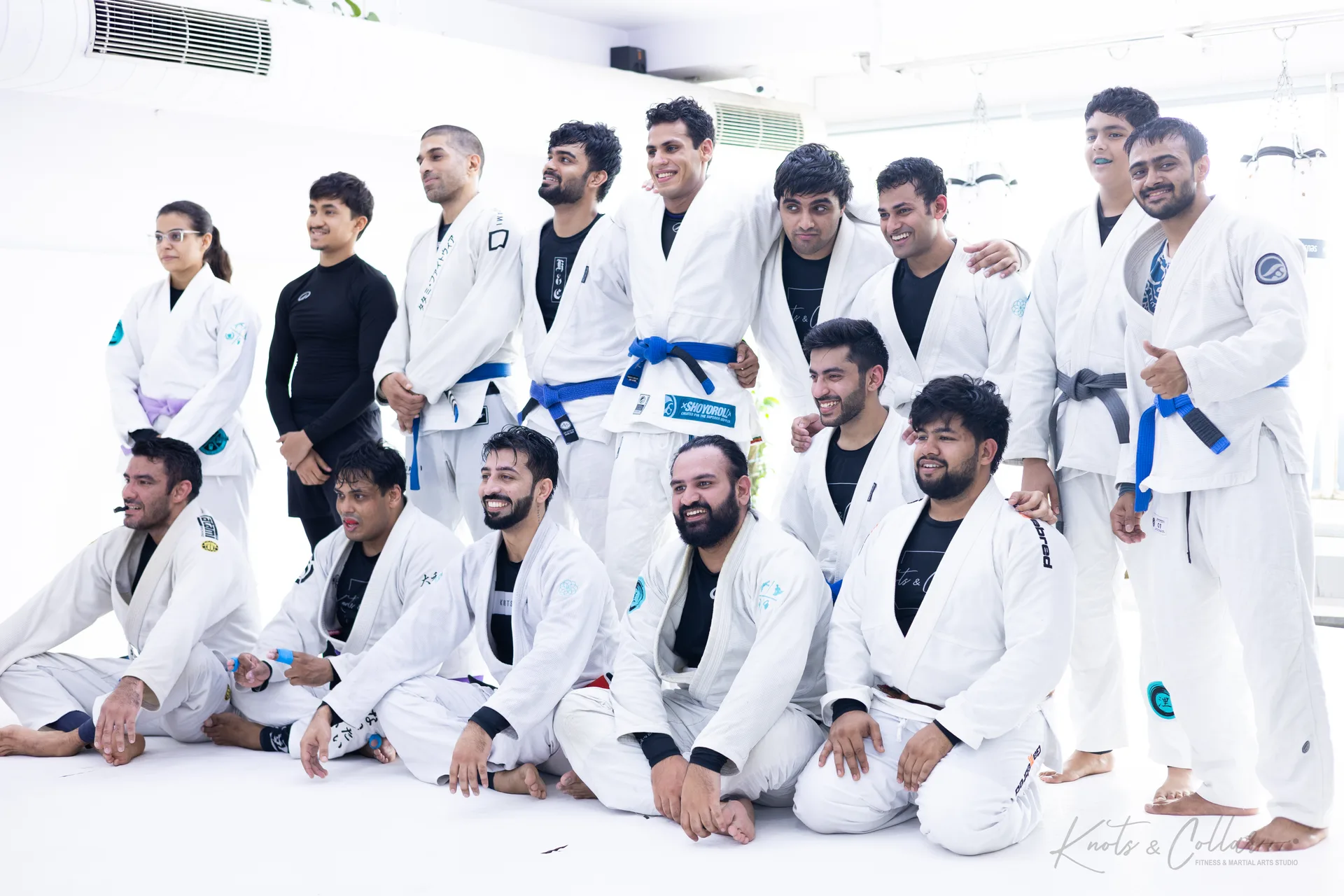
That word — Kindness Over Toughness — is the whole reason we bother to build a gi properly instead of stamping a label on an import. A gi is the first thing you put on before you learn to look after a training partner. We would like it to be honest all the way through, which is really just our philosophy stitched into cloth.
If you would like to see the gi and our other training apparel, have a look at our merchandise. And if you would rather feel it on the mat first, come and schedule a visit — pull on a gi, roll a few rounds, and decide for yourself.
FAQs
Is the Knots & Collar BJJ gi actually made in India?
Yes. We build our BJJ gi in India end to end — Made in Bharat, thread to packaging. The cotton, the weaving, the cutting, the stitching and the final packing all happen here, so we can stand behind every seam.
What GSM is the Knots & Collar gi, and is that good for daily training?
It is a 380 GSM gi. That mid-weight sits in a practical range for daily rolling in Delhi — sturdy enough to hold up to gripping and washing several times a week, without the heaviness of a competition-only jacket.
How much will my new BJJ gi shrink?
A cotton gi will shrink a little on its first few washes. Wash it in cold water and hang-dry it, and the shrinkage stays modest and predictable. We size and pre-shrink with daily training in mind, so the gi settles rather than surprises you.
How should I care for my BJJ gi so it lasts?
Wash it cold after every session, hang-dry it out of direct sun, and never leave it damp in your bag. Skip hot dryers and bleach. Treated this way, a well-built 380 GSM gi stays strong through years of training.