
Surviving Your First Six Months as a BJJ White Belt

Almost everyone who has ever earned a coloured belt in Brazilian Jiu-Jitsu once stood at the edge of the mat as a nervous white belt, unsure of what grips to look for. If you are in your first six months, this guide is for you. It is not about tips and tricks. It is about what those early months honestly feel like, and how to keep showing up long enough for the difficult, wonderful thing to start making sense.
What the first few weeks really feel like
Let us be plain. Your first few weeks as a BJJ white belt can feel overwhelming. You will hear words you do not understand — guard, mount, sweep, base — and you will be asked to move your body in ways it has never moved. You will get tired faster than you expect. You will forget a technique roughly four seconds after it is shown to you. This is normal. It happens to nearly everyone, including people who go on to train for years.
What surprises most beginners is how mentally busy it all is. Brazilian Jiu-Jitsu is often described as physical chess, and in the early weeks you are learning the rules of the board while someone is already moving their pieces. That sense of being a step behind is not a personal failing. It is the honest starting point of a genuine skill. The people who look smooth on the mat felt exactly this way once.
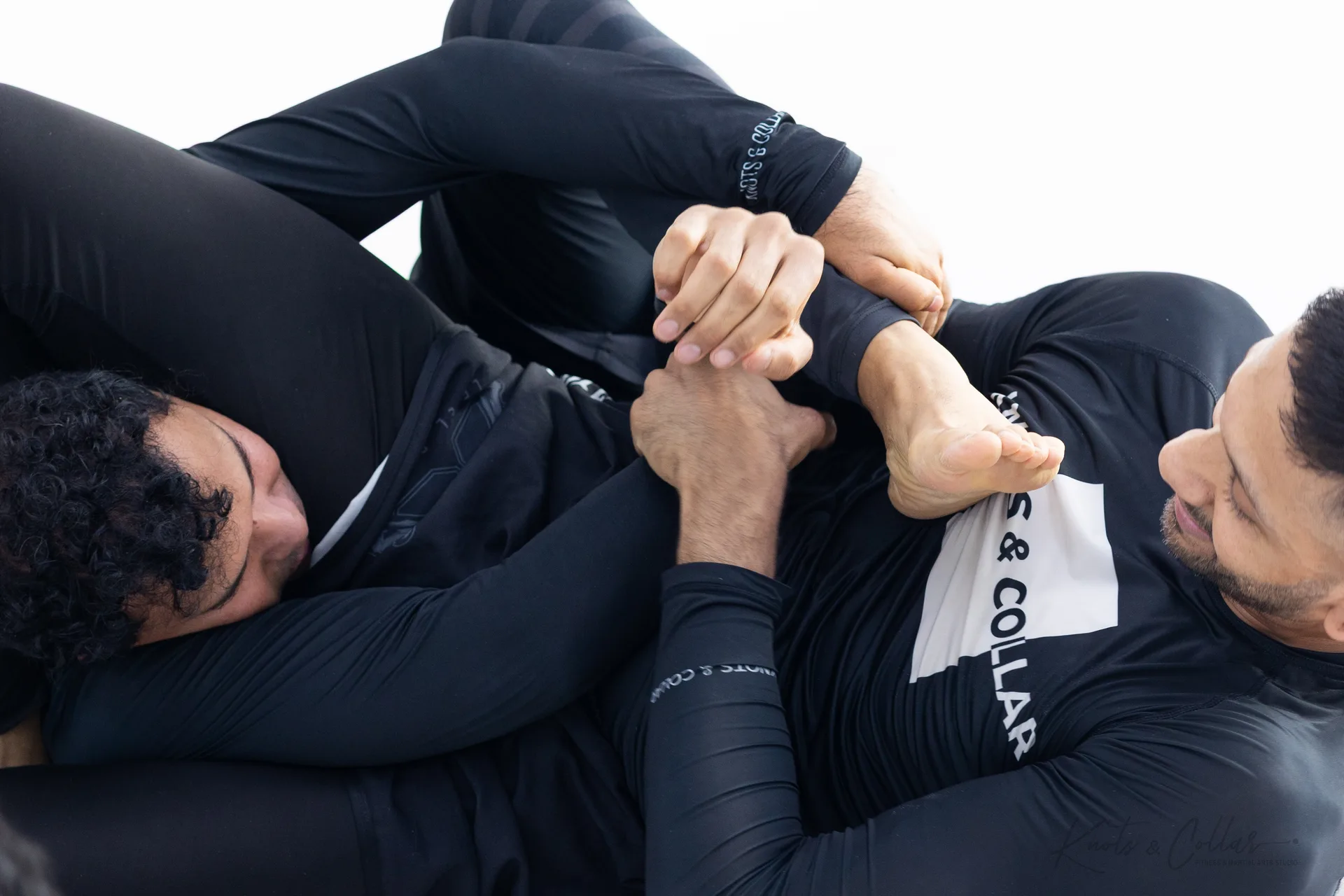
Tapping is learning, not losing
Here is the single idea that will change your first six months more than any technique: tapping is not losing. Tapping — a clear tap on your partner or the mat — is simply how you say, "This position is finished, let us reset." It keeps you safe. It keeps your partner safe. And every person in the room does it, from the newest white belt to the most experienced black belt.
In your early months you will tap a lot. You will get caught in submissions you did not see coming, and you will tap, and you will start again. Try to reframe each tap as a small, free lesson. A tap tells you exactly where a gap in your game is. The student who taps ten times in a round and stays curious about why will improve faster than the student who fights to avoid tapping at any cost. Ego protects nothing here. Tapping teaches everything.
Leaving your ego at the door
This is the harder half of the same lesson. Brazilian Jiu-Jitsu has a quiet way of showing you the truth about where you are. Someone smaller, older, or lighter than you may control you completely, and there is no way to argue with it. That can sting the first few times. It can also be one of the most freeing experiences of your adult life, because once you accept it, you stop performing and start learning.
At Knots & Collar we train under a simple idea — kindness over toughness. That is not softness. It means the room is a place to learn, not a place to prove something. Your training partners are not opponents to defeat. They are people helping you get better, and you are helping them. When you leave your ego at the door, you can relax, ask questions, make mistakes out loud, and absorb far more than the student who is busy protecting an image. Surviving your first six months as a white belt is, in large part, about making peace with being a beginner.

The quiet power of just showing up
If you take one practical thing from this article, take this: the white belts who make it are the ones who keep showing up. Not the most athletic, not the most naturally coordinated — the ones who come to class two or three times a week, week after week, even when they feel clumsy, even when they lose every roll.
Progress in Brazilian Jiu-Jitsu is not a straight line. Some weeks you will feel sharp and some weeks you will feel worse than when you started. That is the normal texture of learning, and it is not a reason to stop. Consistency quietly does its work in the background. Two steady sessions a week, held for six months, will take you somewhere that a single burst of enthusiasm never will. Showing up is a skill in itself, and it is the one that underwrites all the others. If you would like a fuller picture of how to build the habit, our beginner's checklist for starting BJJ in Delhi walks through the first practical steps.
Common beginner mistakes to expect
Certain patterns show up again and again in the first six months. Knowing them in advance takes some of the sting out of them.
The first is using too much strength. New white belts tend to grip hard, hold their breath, and muscle through everything. It is exhausting and it works against the very thing Brazilian Jiu-Jitsu teaches — leverage and timing over raw force. Learning to breathe and relax under pressure is a genuine skill, and it takes time.
The second is skipping the fundamentals in a rush to learn flashy submissions. The unglamorous basics — posture, base, escapes, how to move your hips — are what everything else is built on. The third is comparing yourself to others, especially to people who started months or years before you. Their progress is not a scoreboard for yours. The fourth is treating hygiene and etiquette as afterthoughts; they are part of the discipline, and they matter to everyone you train with. Our note on the foundation of etiquette, hygiene and discipline covers what is expected and why.
How to speed up your progress
You cannot rush skill, but you can train in a way that wastes less time. Come a little early and watch the more experienced students move. Ask your instructor and partners questions — most people are glad to explain. After class, spend two minutes writing down the one thing you want to remember, because a written note survives longer than a tired memory. Focus on escapes and defence early; being comfortable in bad positions removes the fear that makes beginners tense and clumsy.
Above all, be deliberate about what you practise rather than trying to win every roll. Learning outpaces winning at this stage. If you want a deeper look at what genuinely moves the needle, we have written a companion piece on how to improve at BJJ faster with ten things that actually work.
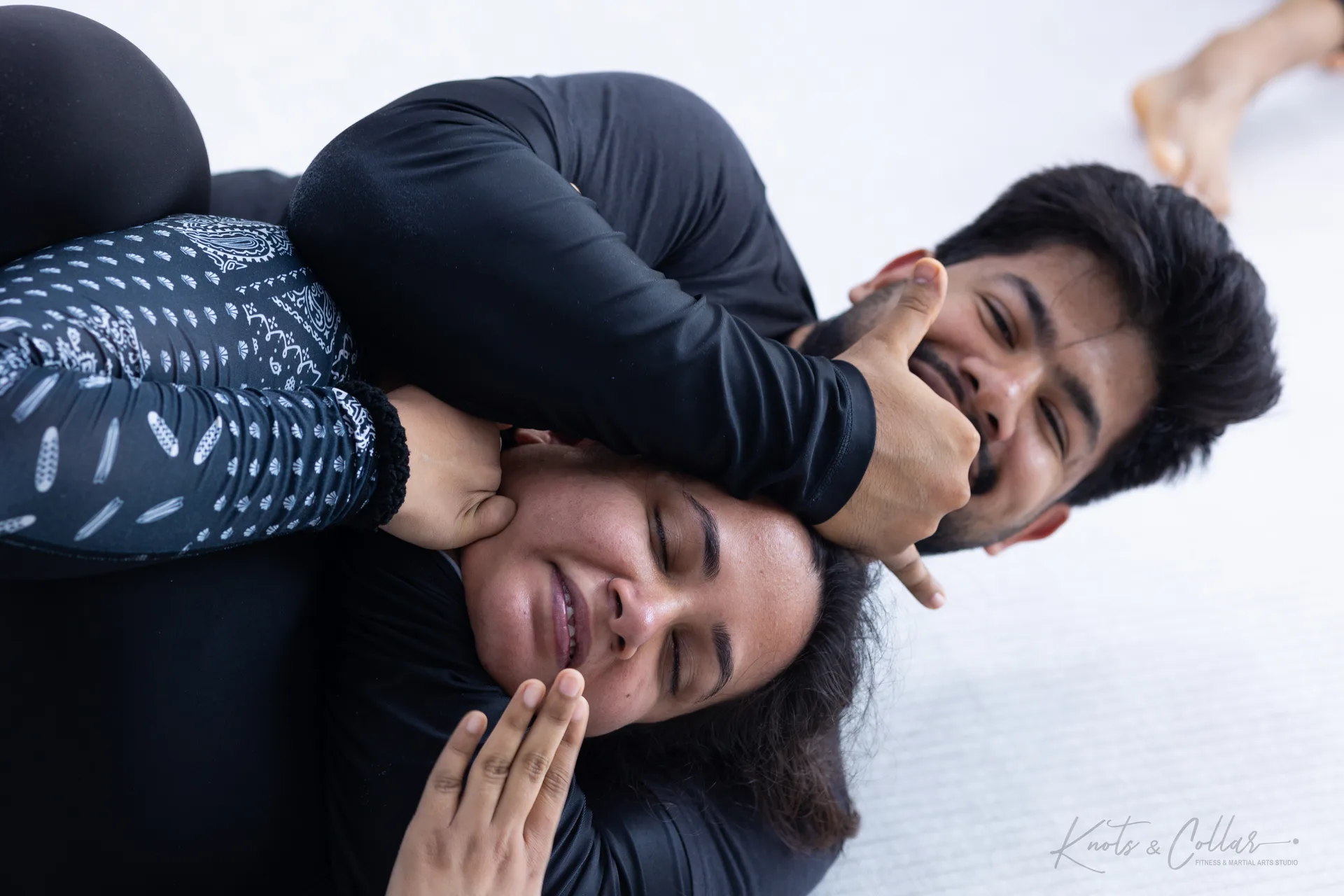
When it starts to click
Somewhere in the first six months — often around the three to four month mark — something shifts. You will notice you saw a sweep coming before it happened. You will recover a position you would have lost a month ago. You will understand a word your instructor uses without having to ask. These moments are small at first, and then they arrive more often.
That is the point where surviving turns into training. The panic quiets down, the movements start to feel less foreign, and you begin to see the structure underneath the chaos. You are still a white belt, and there is a long, rewarding road ahead — you can read about the whole journey in our guide to the BJJ belt system from white to black belt. But you will no longer feel like you are drowning. You will feel like you are learning. That feeling is what keeps people on the mats for years.
If you are thinking about starting, or you have started somewhere and want a room that trains with patience and care, you are welcome to come and watch a class or step on the mat with us in Defence Colony. There is no pressure and no rush. You can schedule a visit whenever you are ready, and we will meet you exactly where you are.
FAQs
How long does it take to stop feeling lost as a BJJ white belt?
For most people it takes about three to six months of steady training — two or three sessions a week — before the panic settles and class starts to make sense. The early weeks feel chaotic for almost everyone. It is not a sign that Brazilian Jiu-Jitsu is wrong for you. It is simply what learning a new physical language feels like at the start.
Is tapping in BJJ a sign that I am losing?
No. Tapping is how you tell a training partner that a position is complete, so you both stay safe and can start again. Every belt in the room taps, including black belts. In your first six months you will tap often, and each tap shows you a gap to work on. Tapping is information, not defeat.
How many times a week should a white belt train BJJ?
Two to three sessions a week is a sustainable rhythm for most beginners. That is often enough to build steady progress without burning out or overloading your body while it adjusts. Consistency over months matters far more than intensity in any single week.
Do I need to be fit before starting BJJ as a white belt?
No. You do not need to arrive fit, flexible, or experienced. The training itself builds those things over time. Beginners of many ages and body types start at Knots & Collar in Defence Colony, New Delhi, and the early classes are structured so you can learn at your own pace.