
The Mount: A Plain Guide to One of BJJ's Strongest Positions
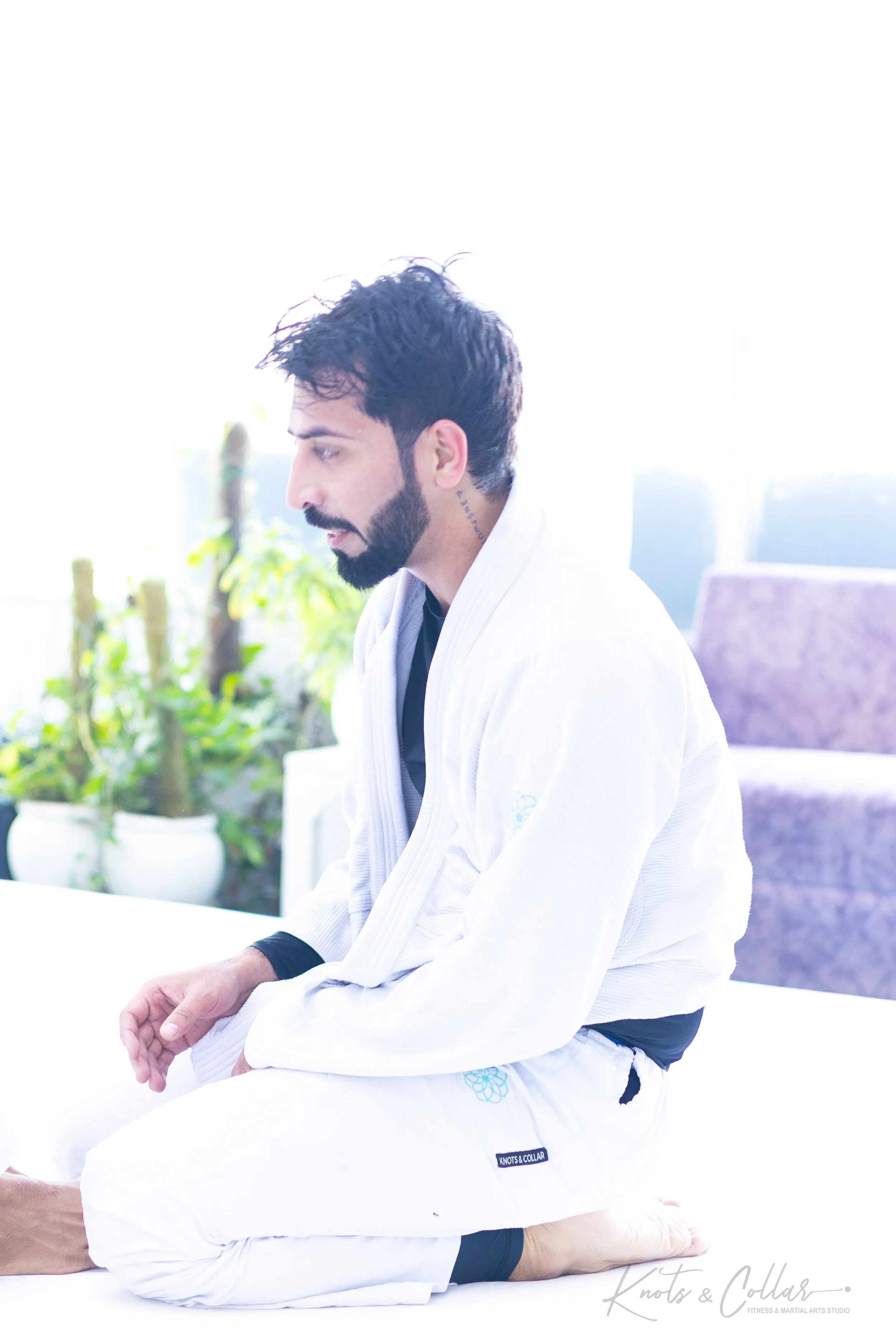
If you have watched even a little Brazilian Jiu-Jitsu, you have seen it — one person sitting on the other's chest, calm and heavy, while the person underneath works hard just to breathe. This is a plain, friendly guide to the BJJ mount: why it controls so well, how to stay balanced on top, and how to stay calm and escape from underneath.
Of all the pins in Brazilian Jiu-Jitsu, the mount is the one that looks the most decisive from the outside, and it usually is. The BJJ mount is the position where you sit on top of your partner, your hips over their torso and your knees on the mat either side of them, facing their head. From there your weight presses down through their chest while your own hands stay completely free. That simple arrangement — you free, them loaded — is what makes the mount such a powerful place to be, and learning both sides of it is a real milestone on the mats.
At Knots & Collar in Defence Colony, New Delhi, the mount is part of nearly every beginner's first weeks. We teach in the De La Riva lineage, in both Gi and No-Gi, seven days a week, and we introduce the top game and the escapes together so that neither side feels like a mystery. This guide walks through the ideas you will meet first.
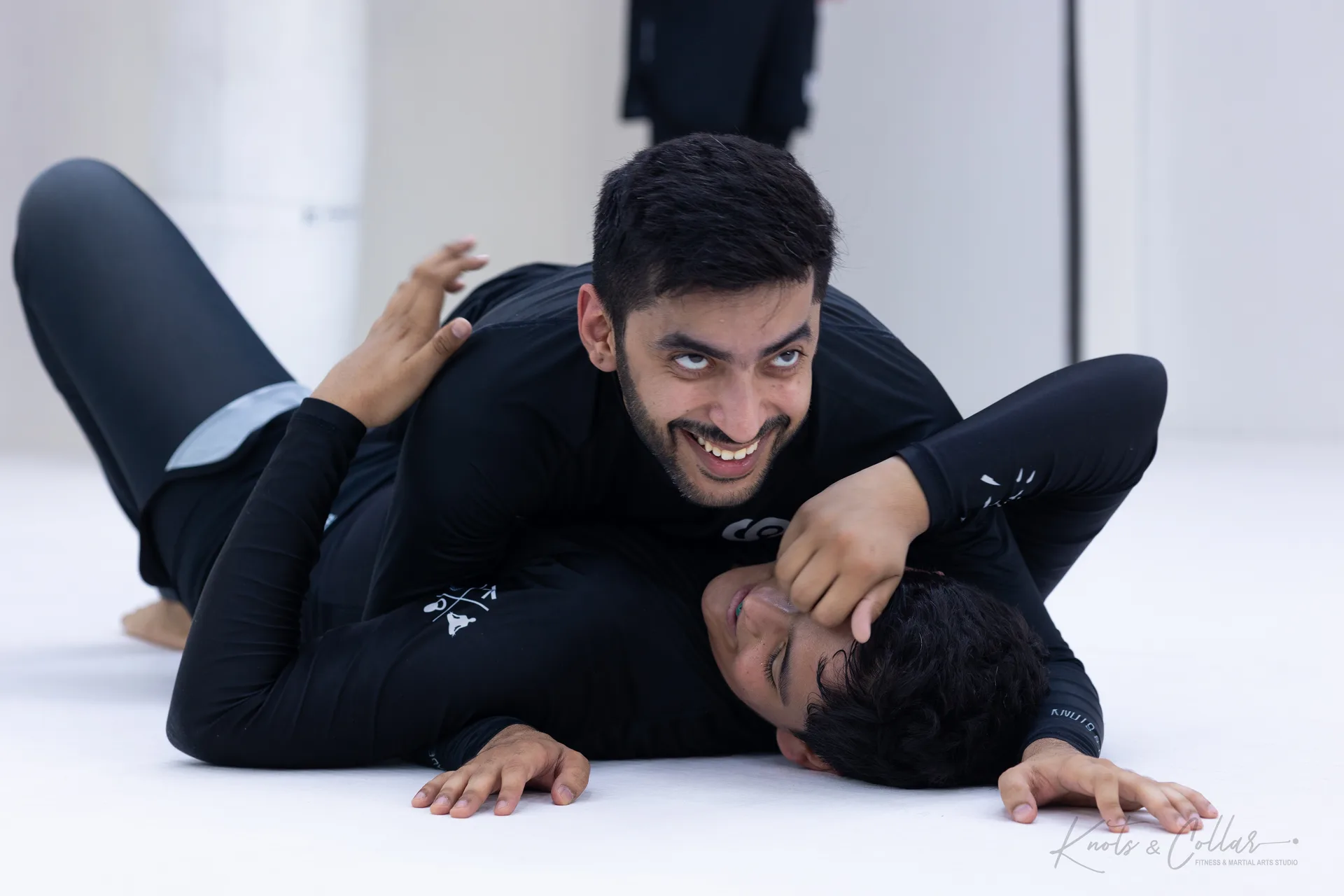
What the mount is, and why it controls so well
The mount sits at the top of what people sometimes call the positional hierarchy. In plain terms, that means it is one of the positions where the top person has the most control and the bottom person has the most work to do. You are seated across your partner's body, roughly over their hips or chest, with your weight settled down through them and both of your arms free to reach, post and attack.
The reason this is so strong is quiet and simple. Your partner has to carry your weight and defend themselves at the same time, using the same tired limbs, while you only have to do one thing — attack. Every breath they take has to lift you first. Over a minute or two that adds up, and it is why a calmer, lighter person who understands the mount can control a stronger person who does not. Control is not about crushing; it is about making their job harder than yours.
Staying heavy and keeping your balance
The single most useful idea on top is to be heavy in the right place. Beginners often try to stay upright and stiff, arms braced on the mat for balance, and that is exactly what makes them easy to tip over. The weight goes into their own hands instead of into their partner. The habit to build is the opposite: relax your weight down onto your partner's chest, keep your hips low, and let your legs and feet do the balancing rather than your hands.
A good phrase to carry is "heavy hips, light hands". If your hands are free, they are available to attack; if they are holding you up, they are doing your partner's defending for them. When your partner bridges and rolls to buck you off, you meet it by widening your base and posting a hand out only for that instant, then bringing it straight back. Balance in the mount is a moving thing — you are always making tiny adjustments, staying settled through the middle while your limbs answer whatever they try.
Low mount and high mount — two heights, two jobs
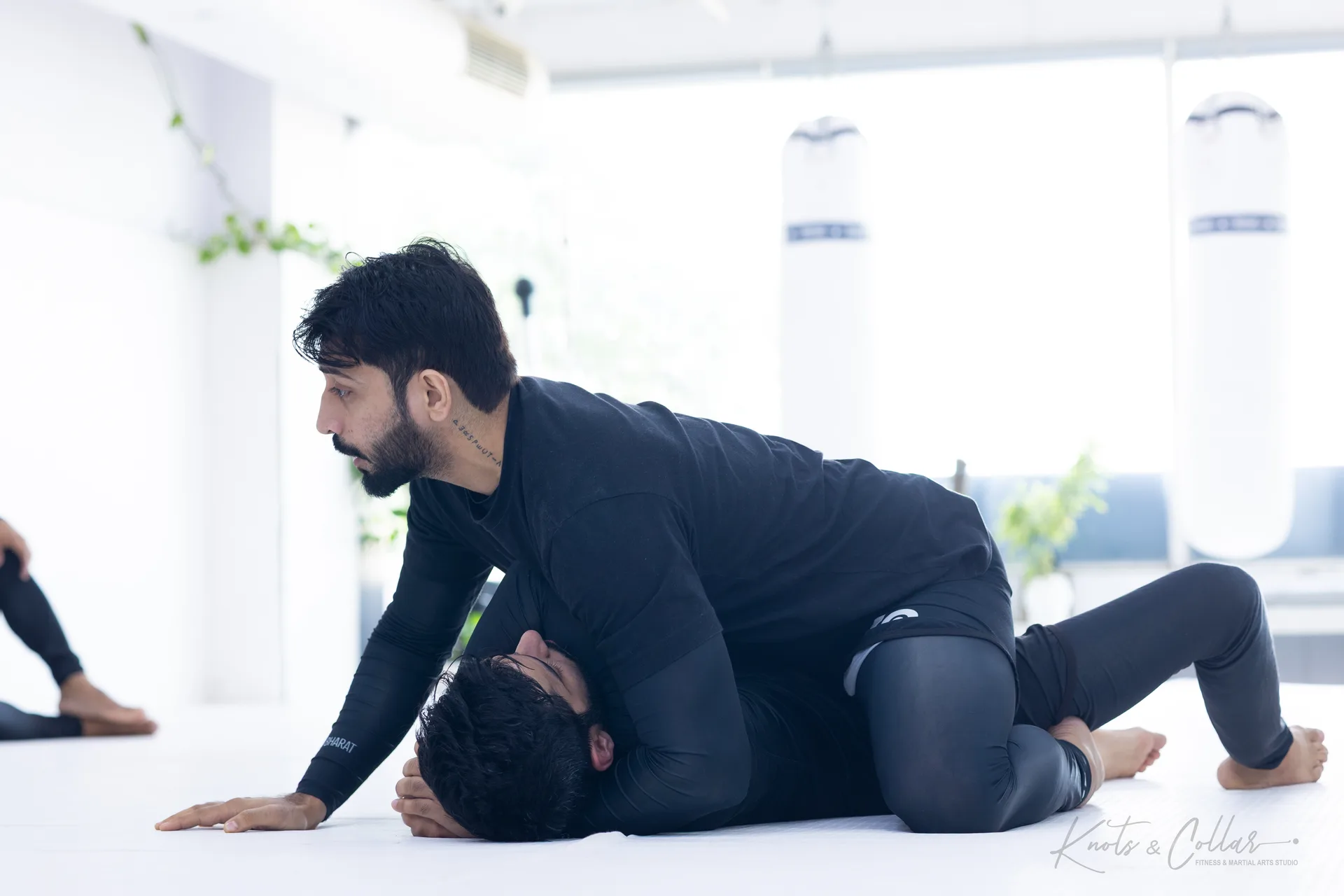
As you settle in, you will hear people talk about low mount and high mount. These are not different positions so much as two heights of the same one, and each does a different job.
In low mount your knees sit low, down near your partner's hips, and your feet hook underneath their legs so you are pinched on tight. This is the control setting. It is very hard to roll someone off from here, because your hooks connect you to their base and your weight is spread low and wide. Low mount is where you go to settle, to catch your breath, and to shut down their attempts to escape before you do anything else.
In high mount you climb your knees up the body towards the armpits, so you are sitting higher on their chest. You give up a little of that rolling stability, but in return you get much better access to their arms and neck, and you pin their upper body so they cannot turn in to defend. The natural rhythm, then, is to hold low mount to control and to climb to high mount to attack — settle, then advance. Learning when to sit tight and when to climb is a big part of getting comfortable on top.
The attacks the mount opens up
Because your hands are free and your partner's upper body is pinned, the mount naturally opens a range of attacks — and you do not need many to be effective. In the Gi, the collar is right there in front of you, which sets up chokes that use the jacket. Whether you train in the Gi or without it, the arms become targets too: when your partner reaches up to push you away, they offer you the very limb you want, and the mount flows readily into armlocks and into taking the back when they turn away.
That last point is worth holding onto. A common beginner worry is that the person underneath will simply turn onto their front to hide their neck and arms. In BJJ that turn is often a gift, because it hands you their back — an even stronger position. So the mount is rarely a dead end for the top person; it tends to lead somewhere useful whichever way their defence goes. If you would like a fuller picture of how positions connect, our guide to BJJ guard types is a good companion, since the guard is what the bottom player is trying to recover.
Underneath the mount — staying calm and framing to escape
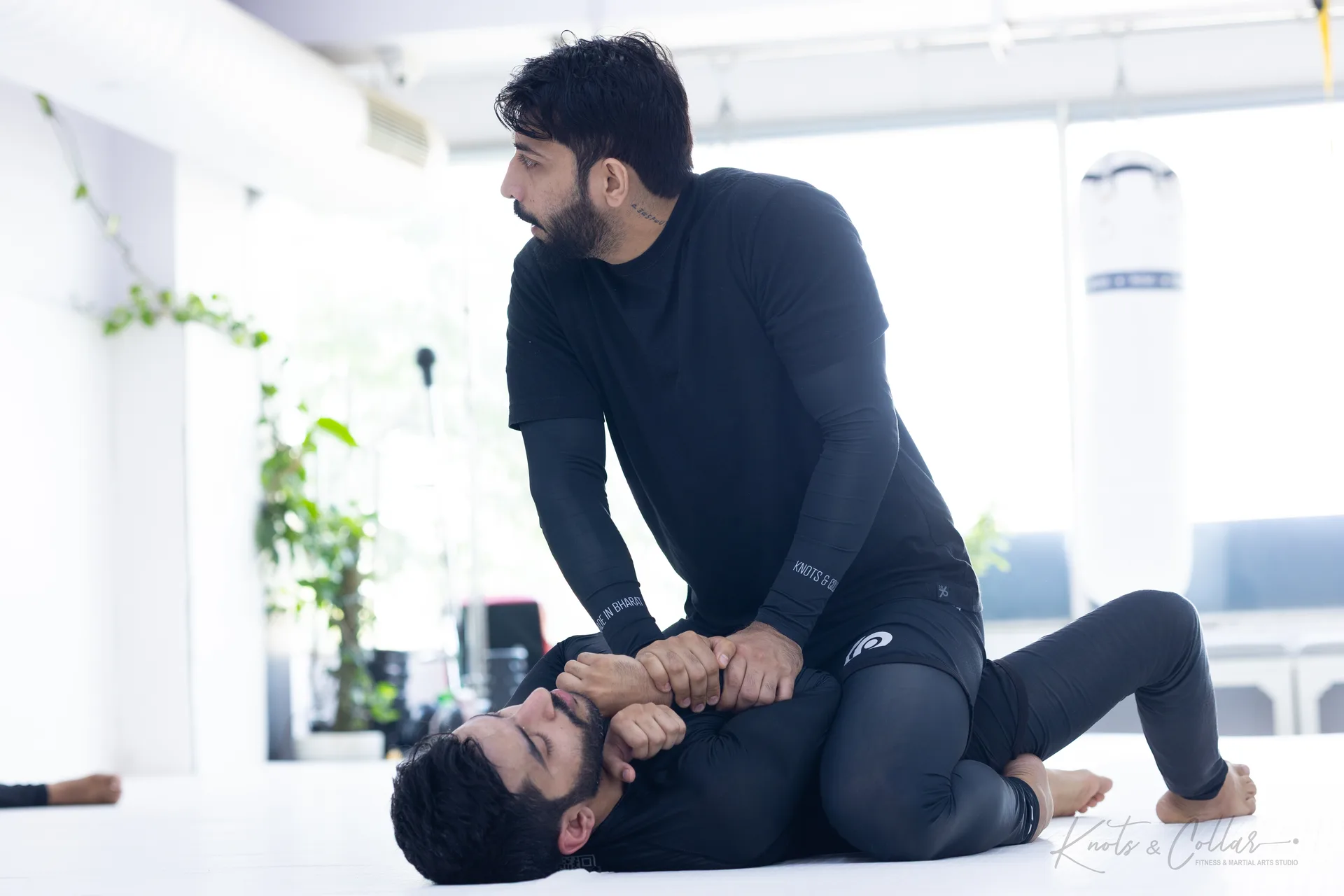
Now for the side that feels less comfortable at first. Being mounted is a demanding place to be, and the instinct is to panic and heave with everything you have. That is the one thing that tends to make it worse, because wild effort tires you out and often feeds your partner the space they want. The first skill of the bottom position is not an escape at all — it is staying calm and breathing.
From there the work is about frames. A frame is a firm structure you make with your arms — forearms and elbows — to hold space and protect your neck. Keep your elbows tight to your sides so there is no gap to feed an arm into, protect your neck with your hands, and turn slightly onto your side rather than lying flat. Once you have taken away the immediate attacks, you make your escape: a strong bridge over one shoulder to load your partner's weight forward, or an elbow-and-knee escape where you shrimp your hips out and thread a knee back in to recover your guard. Calm first, defend second, escape third — always in that order. We drill this staying-calm-under-pressure habit from a student's very first sessions, and it carries far beyond the mount. Our wider look at how to escape bad positions in BJJ goes deeper into that mindset.
How the mount fits into your wider game
The mount rewards patience more than athleticism, which is one of the reasons it suits the way we teach. You do not need to be big or explosive to hold a good mount; you need to understand where your weight belongs and to stay unhurried while your partner works. That same calm is what lets you escape one when the roles are reversed. If you want these ideas to click sooner, our notes on how to improve at BJJ faster may help, and if you are new to the art, the complete guide to BJJ in India is a gentle place to start.
Reading about the mount will only take you so far, though. It is a feeling — the settle of the hips, the moment you sense a bridge coming, the small frame that buys you room underneath — and that feeling only arrives on the mats, with a patient partner and a bit of time. If you would like to try it in person, you are welcome to schedule a visit and come and see how a class runs. Kindness over toughness, always.
FAQs
Why is the mount such a strong position in BJJ?
The mount lets you sit on your partner's chest or hips with your full weight bearing down while your own limbs stay free. They carry your weight and defend at the same time, which is tiring, so the mount gives the top person control, time and a clear path to attacks. That is why BJJ treats it as one of the strongest positions on the mat.
What is the difference between low mount and high mount?
In low mount your knees sit low near your partner's hips and your feet hook underneath, which makes you very hard to roll off — it is the control position. In high mount you climb your knees up towards the armpits, which trades a little stability for far better access to the arms and neck. Most people hold low mount to settle, then climb to high mount to attack.
How do you escape the mount in BJJ?
The first job is to stay calm and stop the attacks, not to explode straight away. You frame with your arms to protect your neck and make a little space, keep your elbows tight to your sides, and then use a bridge or an elbow-and-knee escape to recover your guard. It is a skill we drill from day one at Knots & Collar.
Do beginners learn the mount early at Knots & Collar?
Yes. The mount is part of a beginner's first weeks, both on top and underneath. We teach it in the De La Riva lineage, in Gi and No-Gi, seven days a week in Defence Colony, New Delhi, so students learn to hold it, attack from it and escape it in a steady, friendly order.