
The Solo BJJ Warm-Up Movements Every Beginner Learns First
Walk into almost any Brazilian Jiu-Jitsu class and the first ten minutes look the same: bodies moving up and down the mat, hips shrimping, backs bridging, people rising to their feet and rolling over their shoulders. It can look like nothing more than a way to break a sweat. It is far more than that. These solo BJJ warm-up movements are the alphabet of the ground game — the small motions every technique is spelled out from. This is a plain guide to the ones every beginner learns first at Knots & Collar in Defence Colony, New Delhi: what each teaches, and why warming up this way protects you. It is general information, not medical advice.
Why the warm-up is a lesson, not a formality
A good BJJ warm-up does two jobs at once, and that is the reason it earns its place at the start of every class. The first job is the obvious one: it prepares the body. Jiu-Jitsu asks a great deal of your hips, spine, neck, and shoulders, and cold joints do not respond well to sudden load. A few minutes of movement raises the heart rate, wakes up the tissue, and turns muscle that would tear into muscle that gives. That alone is worth the time.
The second job is quieter and, over the months, more important. The movements we warm up with are not chosen at random. They are the exact motions you will use in live grappling — to escape a pin, to reverse a position, to get back to your feet safely. Every repetition in the warm-up is a repetition of a fundamental. By the time a beginner has shrimped up the mat a few hundred times, the hip escape is no longer something they think about; it is something their body simply does. That is why we treat the warm-up as a lesson.
Shrimping — the hip escape that runs through everything
If there is one movement that defines Brazilian Jiu-Jitsu, it is the shrimp, also called the hip escape. Lying on your back, you plant a foot, bridge slightly onto your shoulders, and push your hips away to the side, ending up angled rather than flat. Done up and down the mat, it looks like an odd shuffle. In a real position, it is how you create the space to escape from underneath a heavier opponent.
What the shrimp teaches is the single most useful idea in the ground game: that you move your hips first, and the rest of your body follows. Beginners instinctively want to push with their arms and muscle their way out of trouble. The shrimp trains the opposite habit. Space is made with the hips, and once you can make space, you can escape almost anything. This is why we drill it in every warm-up, and why it quietly appears inside dozens of techniques you will learn later. Master the shrimp and you have learned the first letter of the alphabet.
Bridging — power from the hips, not the arms
The bridge, sometimes called the upa, is the shrimp's partner. Lying on your back, you plant both feet, drive through your heels, and lift your hips high toward the ceiling, rolling onto your shoulders. On its own it is a simple movement. Paired with a turn, it becomes one of the most reliable escapes in Jiu-Jitsu — the motion that lets a beginner reverse someone sitting on top of them.
Bridging teaches you where your real strength comes from. The hips and legs are far stronger than the arms, and the bridge is how you learn to send that power upward and into an opponent. A student who tries to bench-press their way out of a pin will tire in seconds; a student who bridges will move someone twice their size. Warming up with bridges builds the strength and the timing at once, so that when the moment comes to escape for real, the movement is already familiar. Between them, the shrimp and the bridge cover most of what you need to survive on the bottom, which is exactly why they lead almost every class.
The technical stand-up — getting to your feet safely
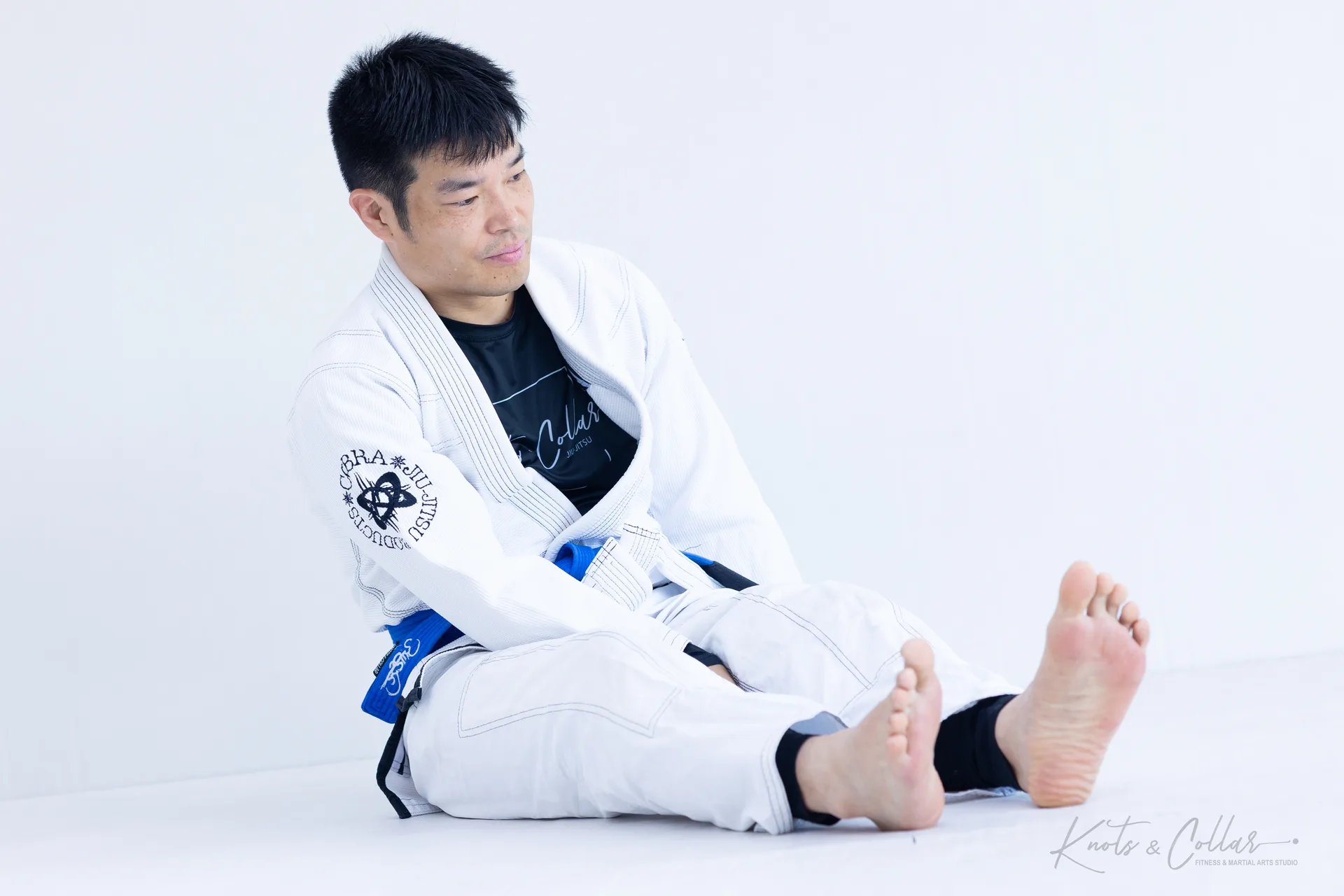
Not all of Jiu-Jitsu happens on your back. The technical stand-up is how you rise from the ground to your feet without exposing yourself along the way. From a seated position you post on one hand and the opposite foot, lift your hips, swing the trapped leg through, and come up already facing forward with a hand ready to protect your space. It is a small sequence, and it is worth more than it looks.
This movement matters most outside the sport. If you are ever knocked to the ground in daily life, standing up carelessly — head down, hands busy, weight forward — is how you get caught. The technical stand-up keeps your base, your guard, and your eyes in the right place the whole way up. We drill it in the warm-up so that getting off the floor safely becomes a reflex rather than a decision. It is one of the clearest examples of a BJJ movement that is practical long before you ever spar.
Forward and backward rolls — learning to be comfortable upside down
Rolls look the most acrobatic of the warm-up movements, and they worry beginners the most, but they are gentler than they appear. The forward roll goes over one shoulder rather than the top of the head, so the neck stays safe, and you finish back on your feet or ready to move. The backward roll reverses it, taking you over a shoulder from a seated or crouched start. Neither is a gymnastics trick. Both are ways of teaching your body to travel through space calmly while inverted.
Jiu-Jitsu constantly turns you upside down — in scrambles, in sweeps, when a position collapses and you have to keep moving. A beginner who panics when the world flips over freezes and gets stuck. A beginner who has rolled a hundred times in the warm-up stays relaxed, keeps rotating, and comes out the other side in a good position. Rolls build that composure. They also teach you to protect your head and neck automatically, which is a habit worth having long before anyone is trying to pass your guard. Start slow, close to the ground, and let the movement become smooth before you ever add speed.
Breakfalls — the skill that protects you when you land
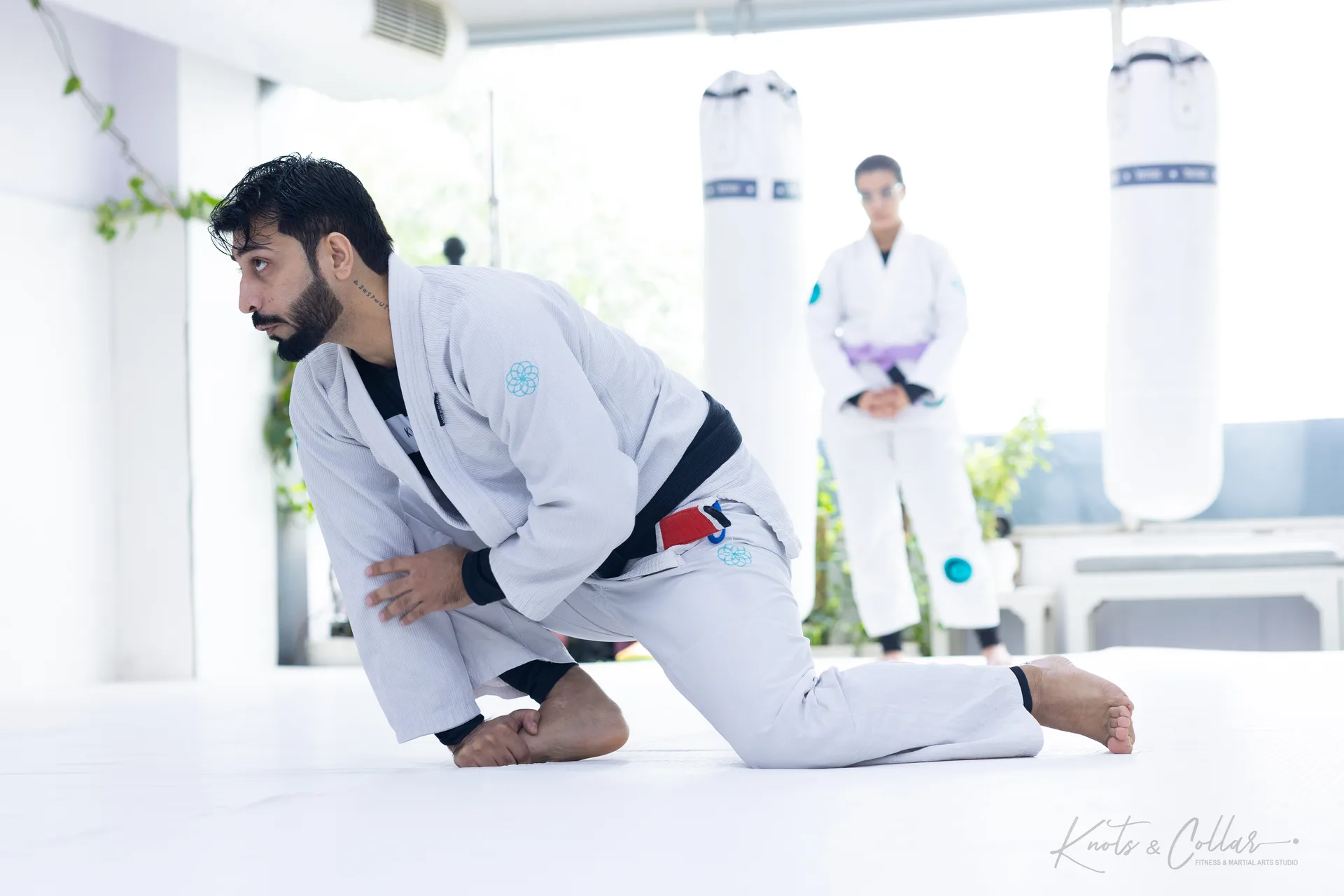
The breakfall is the movement that keeps everything else safe. When you are swept, thrown, or taken down, the breakfall is how you meet the ground: you spread the impact across a broad surface, slap the mat with an open arm to disperse the force, tuck your chin so your head never touches down, and land relaxed rather than braced. A beginner who has learned to breakfall can be taken down and simply get back up. A beginner who has not will instinctively reach out a stiff arm to catch themselves, which is exactly how minor injuries happen.
This is the clearest link between the warm-up and staying healthy in the sport. Learning to fall well is not glamorous, and it never shows up on a highlight reel, but it is the foundation that lets you train hard for years. We spend time on it in the warm-up precisely because it protects both you and your partners. If you would like more on training in a way that keeps you on the mat for the long haul, our guide on how to train BJJ without getting injured covers the wider habits, and it begins, unsurprisingly, with warming up properly.
The alphabet of the ground game
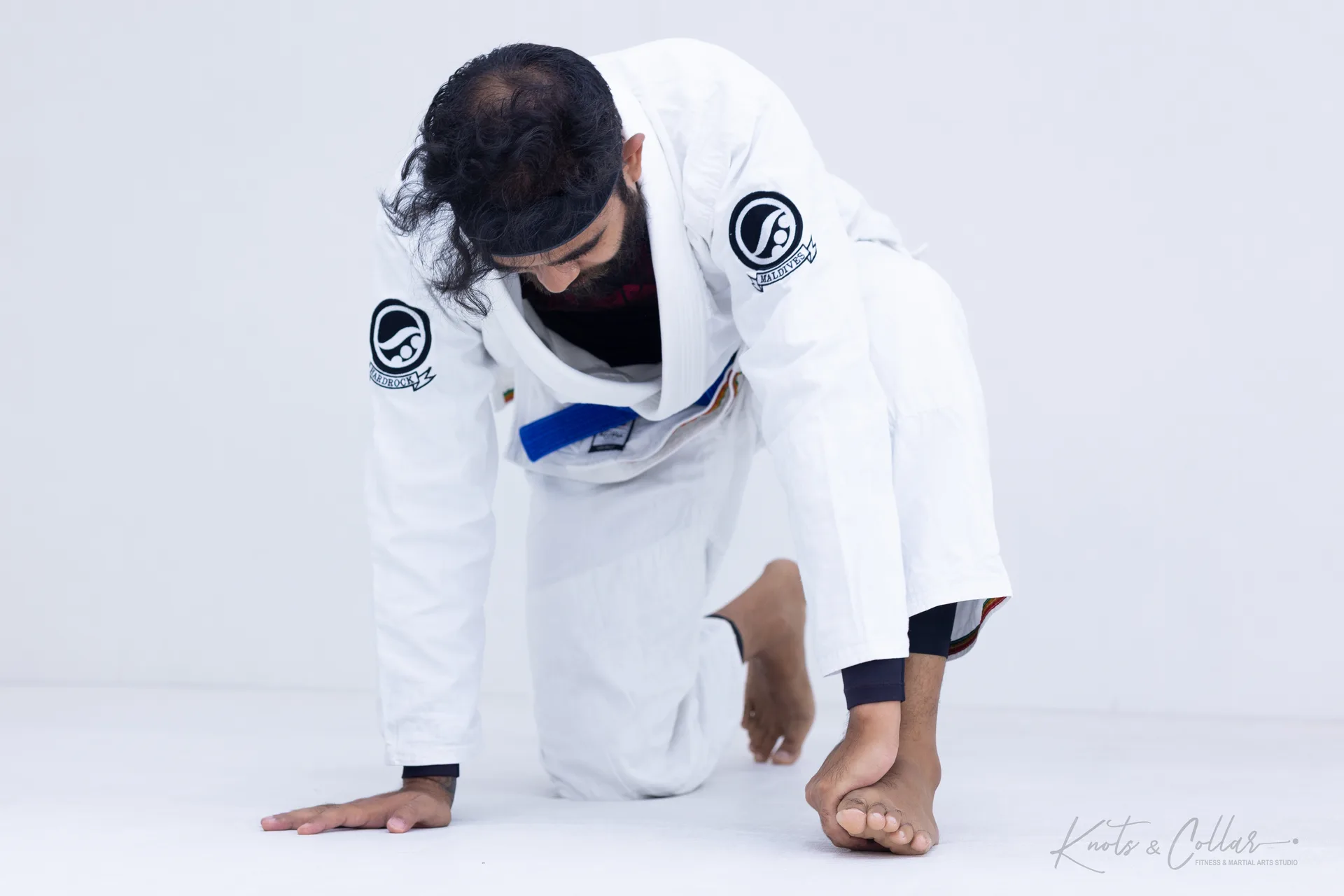
Put these movements together and you have the vocabulary the rest of Jiu-Jitsu is written in. The shrimp and the bridge are how you escape and reverse. The technical stand-up is how you get to your feet. Rolls and breakfalls are how you stay calm and safe when a position collapses. Almost every technique you will ever learn is a combination of these solo motions, layered onto a partner. That is what we mean when we call them the alphabet: learn the letters well, and the words come far more easily.
None of it needs to be rushed. Beginners feel clumsy for the first few weeks, and that is exactly as it should be. Progress in Jiu-Jitsu comes from honest, unhurried repetition — turning up, warming up, and letting the movements settle into the body over months rather than forcing them in a day. That patience is the heart of Kindness Over Toughness, the way we teach at Knots & Collar. If you want to see how the earliest weeks unfold, our guide to a white belt's first six months maps the road ahead, and for the broader picture of the art in this country, our complete guide to BJJ in India is a good place to start. To keep improving once the basics are in place, our notes on how to improve at BJJ faster lean, as always, on consistency over intensity.
These movements are best learned in person, with an eye on your technique and a mat under your feet. If you would like to try them, you are welcome to come and watch a class or take your first steps with us. Schedule a visit whenever you are ready. There is no rush, and there never should be. This article is general guidance, not medical advice; if you are managing an injury, please speak to a doctor or physiotherapist before you begin.
FAQs
What are the basic BJJ warm-up movements for beginners?
The core solo movements are shrimping (the hip escape), bridging, the technical stand-up, forward and backward rolls, and breakfalls. Every one of them appears in a beginner's first weeks at Knots & Collar. They are done on your own, with no partner and no risk, and they teach the hip and spine mechanics that the whole ground game is built on.
Why do BJJ classes start with the same movements every time?
Because these BJJ movements are the alphabet of the ground game. Shrimping, bridging, and rolling are not just a way to raise your heart rate; they are the exact motions you will use to escape, to sweep, and to stand up safely. Repeating them warms the body and drills the fundamentals at the same time, which is why they earn their place in every session.
How long does it take to get comfortable with BJJ warm-up movements?
Most beginners feel clumsy for the first few weeks, and that is completely normal. Within a month or two the movements start to feel natural, and after that they become automatic. There is no rush. The point is honest, unhurried repetition, not speed. Comfort comes from turning up regularly, not from forcing it in a single session.
Do I need to be fit or flexible to start BJJ?
No. The warm-up movements are how your fitness and mobility are built, not a test you have to pass first. Beginners of every age and starting point learn shrimping and bridging at their own pace. You improve by doing them, gently and often. This is general guidance, not medical advice; if you are managing an injury, speak to a doctor or physiotherapist first.