
Leg Locks in BJJ, Explained: A Calm Introduction

If you have watched modern Brazilian Jiu-Jitsu, you have probably heard people talk about leg locks with a mix of curiosity and caution. In plain terms, a leg lock is simply a submission that applies controlled pressure to the lower body, and — like every submission — it ends the moment someone taps. This is a general, conceptual introduction to BJJ leg locks: what they are, why they have grown alongside no-gi, and above all why control, communication and tapping early matter so much with this particular family. It is general information, not instruction; the techniques themselves are best learned slowly, in person, under qualified supervision.
What leg locks actually are
A leg lock in Brazilian Jiu-Jitsu is a controlled position that applies slow pressure to a joint of the lower body — the ankle and foot first, and the knee at more advanced stages. Nothing about that pressure needs to be sudden or alarming. Long before it approaches anything uncomfortable, the person caught taps, the position resets, and both partners begin again. That loop is exactly the same one that governs a choke or an armbar; only the part of the body involved has changed.
It helps to think of a leg lock the way you would think of any other submission: as a shared piece of language rather than a fight. When your partner catches your foot, they are pointing at a gap in the way you managed the space between your legs, and you can now work on it. When you catch theirs, the same is true in reverse. The tap is the full stop at the end of a sentence you wrote together. Held to that standard, BJJ leg locks are nothing to fear — they simply ask for a little more patience than most beginners expect.
Why they have grown with modern no-gi
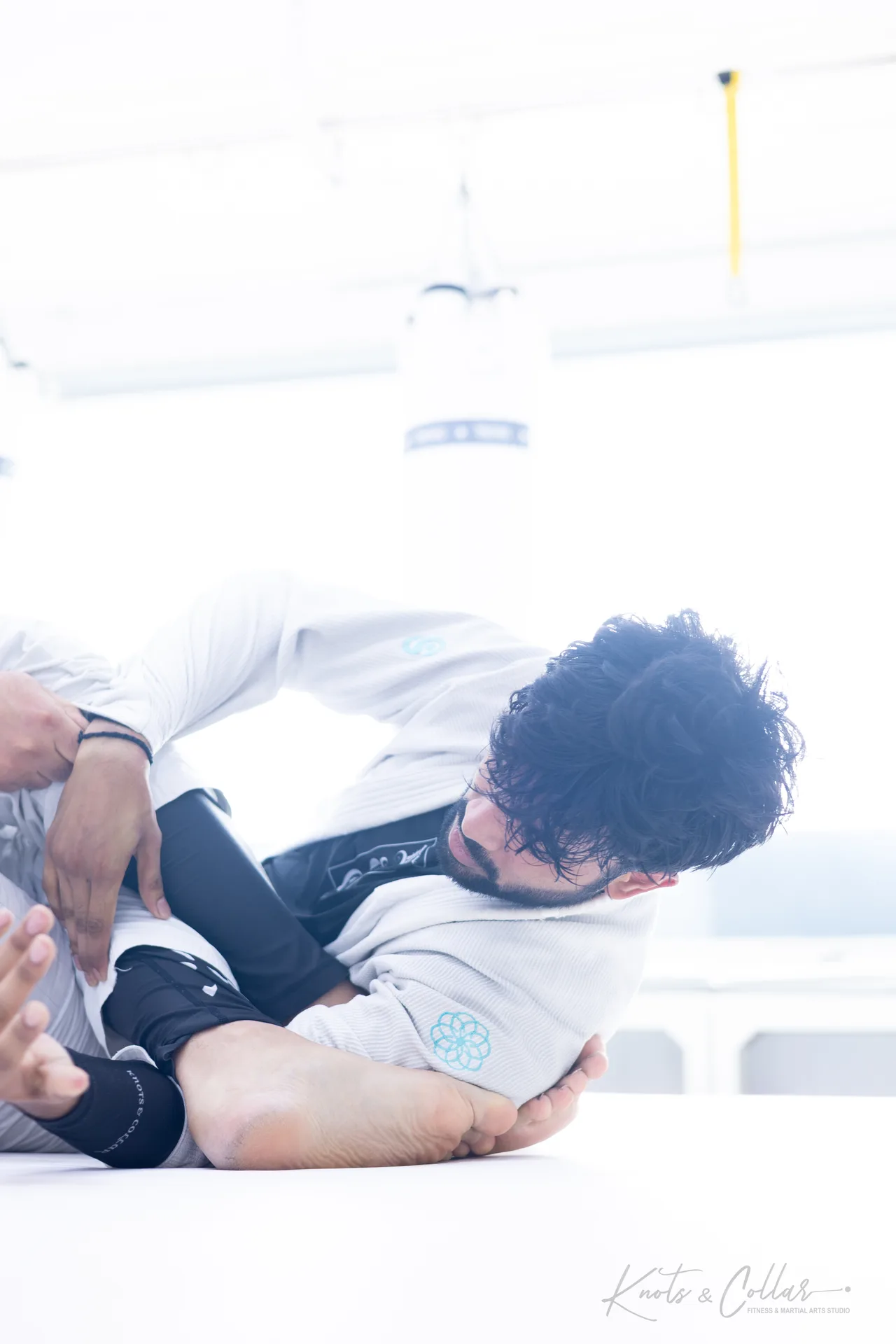
For a long time, leg locks sat at the edges of Brazilian Jiu-Jitsu. Over the last decade or so they have moved much closer to the centre, and the clearest reason is the rise of no-gi grappling. Without the friction and grips of the jacket, the legs become a natural place to build control, and a whole area of the game that was once lightly explored has been studied carefully and taught openly.
This is a healthy development rather than a worrying one. It means the lower body is now treated with the same seriousness as the upper body — understood, drilled slowly, and defended with awareness. If you train no-gi, you will meet BJJ leg locks sooner and more often, which is one of the honest differences between the two styles. Our complete guide to no-gi jiu-jitsu sets out the wider picture of how that game is played, and the growth of leg locks is one of its clearest threads.

The straight ankle lock — a calm starting point
Almost every beginner's first meeting with this family is the straight ankle lock, and there is a good reason it comes first. Its position is comparatively open and easy to understand, its pressure builds slowly and predictably, and both partners can feel clearly what is happening as it forms. That clarity is exactly what makes it a sensible place to begin — you learn to recognise the shape before you ever learn anything more advanced.
At a conceptual level, the straight ankle lock isolates the foot and applies gentle pressure through the ankle. The sensation arrives well before anything is at risk, and the tap comes comfortably inside that margin. Learning it well is less about the finish and more about awareness: knowing how your partner enters the position teaches you to notice it forming, and noticing it forming is the whole foundation of defending it early. That awareness, built slowly on one calm technique, is what makes the rest of the family approachable later rather than intimidating.

Why control matters so much here
Every submission in Brazilian Jiu-Jitsu asks for control, but leg locks ask for a little more, and it is worth being honest about why. Some of the lower-body joints give less warning than the elbow or shoulder, so the margin between "firm" and "too much" rewards a slow, deliberate hand. This is not a reason to avoid leg locks — it is precisely the reason they are taught with such care, and why a patient approach is built into how they are introduced.
In practice, control means applying pressure gradually, watching your partner closely, and treating every rep as something you are building together rather than testing. There is never a reason to apply a leg lock hard or fast in training. The students who learn this family most reliably are almost always the ones who slow down the most, because control is not a limit on progress here — it is the actual skill being learned. If you would like the broader habits that keep training sustainable across every technique, our guide to training BJJ without getting injured sits closely alongside this one.
The etiquette of applying slowly and tapping early
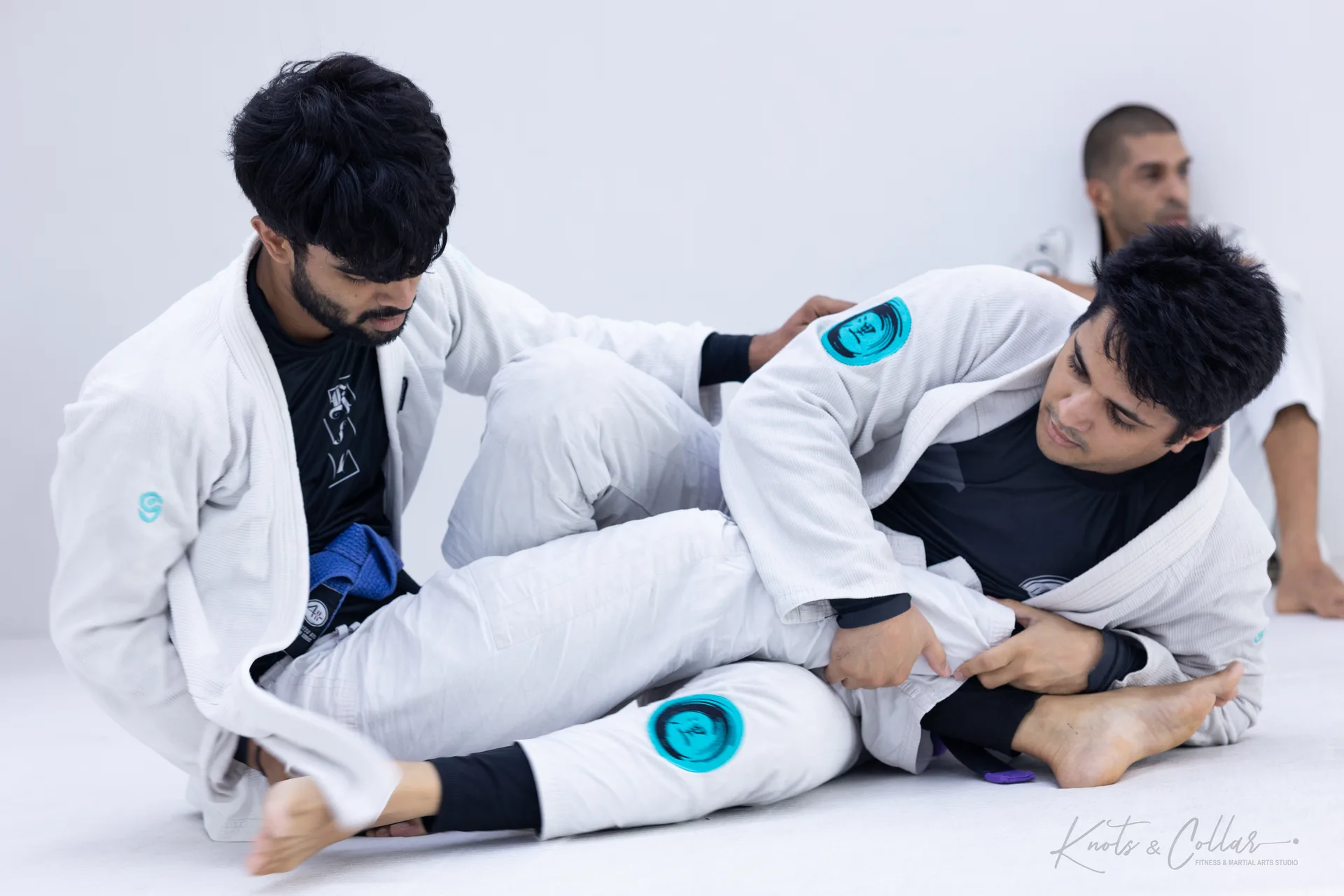
Two habits keep leg locks completely safe, and both are easy to learn from the first day. The first belongs to the person applying the hold: move slowly, feel for your partner's response, and release smoothly the instant they tap. The second belongs to the person caught: tap early and clearly — several firm taps on your partner or the mat, or a spoken "tap" if your hands are occupied — well before anything feels serious. With leg locks in particular, tapping early is not caution to grow out of; it is simply how everyone in the room stays healthy enough to keep training.
There is a small piece of shared courtesy worth naming too. Because some leg locks develop quietly, good partners communicate a little more openly around them — a word before a hard roll, a check-in during drilling, an unhurried release afterwards. None of this slows your learning; it is the culture that lets the family be trained at all. This is exactly what "Kindness Over Toughness" means in practice: the person applying the hold protects their partner as carefully as the person caught protects themselves, and that care is verified, always, by how the room actually behaves.
How leg locks fit a complete game
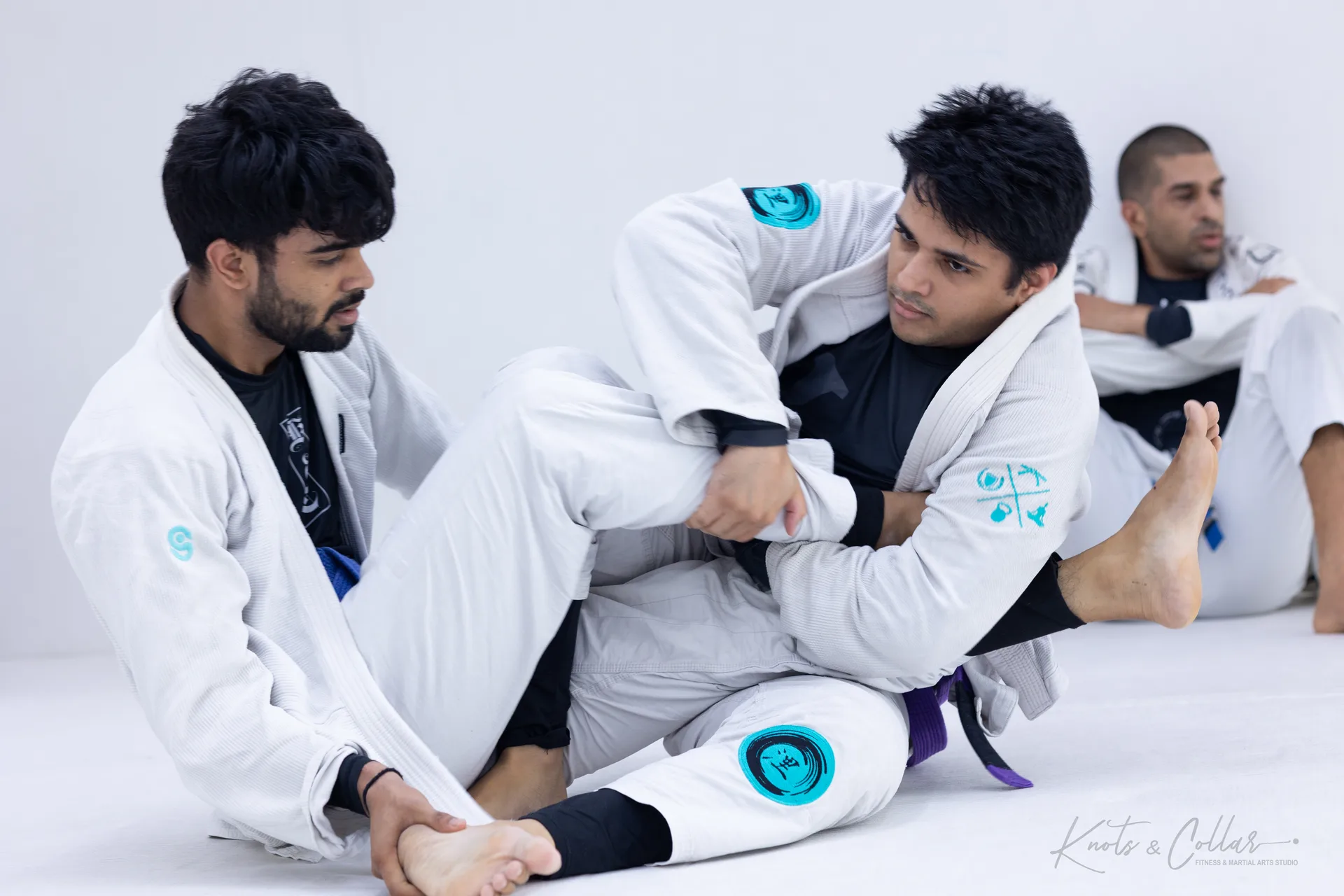
It helps to keep leg locks in proportion. They are one family among several, and they sit most naturally on top of a solid understanding of position, guard and the more familiar submissions. A beginner who spends their early months learning to hold good positions and to move well will find leg locks far easier to add later than one who reaches for them first. If you are still building that base, our overview of the submissions a beginner meets and our guide to guard types give the wider context that makes this family make sense.
Seen this way, BJJ leg locks are neither a shortcut nor a threat. They are a genuine, growing part of a complete game, best learned slowly, with control, and with a partner you are looking after. Brazilian Jiu-Jitsu in India is maturing quickly, and this is one of the areas where careful, patient teaching matters most — a theme we return to in our complete guide to BJJ in India.
If you would like to see how any of this looks in a calm, well-run room, you are welcome to come and watch a class before you decide anything. You can schedule a visit to Knots & Collar in Defence Colony, New Delhi, and take your time.
FAQs
What are leg locks in BJJ?
Leg locks are a family of Brazilian Jiu-Jitsu submissions that apply slow, controlled pressure to the joints of the lower body — most often the ankle, and later the knee. Like any submission, they end well before anything is at risk: the person caught taps, both partners reset, and training continues. They have grown in visibility with modern no-gi, and they reward a calm, patient approach more than a fast one.
Are BJJ leg locks safe to learn as a beginner?
Learned slowly and under qualified supervision, BJJ leg locks are trained safely every day. The safety comes from two habits — the person applying the hold moves with control and stops the instant their partner taps, and the person caught taps early rather than testing it. Leg locks reward this care in particular, which is why they are usually introduced gradually rather than in the first weeks.
What is the safest leg lock for a beginner to start with?
The straight ankle lock is generally the first leg lock a beginner meets, because its position and mechanics are easier to feel and control than the more advanced holds. Understanding it well — how it is entered, and how it feels as it forms — teaches the awareness that makes the whole family calmer to learn later.
Do I need to train no-gi to learn leg locks?
You will meet leg locks sooner in no-gi, where they are especially common, but they belong to Brazilian Jiu-Jitsu as a whole. Whichever style you train, the same principles apply: control comes first, communication with your partner matters, and there is never a reason to apply a leg lock hard or fast in the room.