
Mount Escape That Works Under Pressure: Hip Up, Shoulder Walk, Flip
Flat on your back, someone heavy on your chest, and every bridge just makes you more tired. This full No-Gi class from our mats in New Delhi rebuilds the mount escape around one habit you can rely on even before the escape is there: hips up, shoulder walk.
Everybody has been there. You bridge, and bridge, and nothing happens except that you run out of air. In this class, Professor Binish Sukhija takes the mount escape apart and puts it back together as a process you can run the same way every time, with one rule for when to run it.
“Even if you can’t escape, you are safe. You might not escape, but you are surviving.”
Watch the class first, then use the notes underneath when you drill it.
Class chapters
- 0:00 Intro
- 0:40 Hip up and the shoulder walk
- 3:12 Peel the arm — palm up for safety
- 6:08 Double unders: hips up changes the fight
- 7:44 The escape: head on head, look at 12, kick, flip
- 10:41 Three scenarios: ear to ear, head up, head away
- 13:23 Why hips up: strikes, requirement, process, timing
- 22:34 Ezekiel and the neck hug
- 28:23 Paper cutter choke, no foot trap, flip don’t roll
- 41:34 Rolling
The solo drill: hip up and the shoulder walk
The class starts alone on the mat. The hip up here is not an explosive bridge on the balls of your feet. It is gentle, with your heels close to your backside — a little further is fine, far too far is not — and it should be something you can hold “for a good five minutes, ten minutes”. From there you walk on your shoulders and let your feet follow.
Then the escape movement itself, still solo:
- Pick a side. That foot goes flat, toes sideways, not up.
- Open your hip and flip your pocket onto the mat, as if you were slapping it.
- At the same time, swim your bottom foot through so your base stays wide.
- Don’t rush back to your knees. Stay low and sprawled, on your elbow or forearm.
Hip up, a couple of shoulder walks, kick, flip. Five times to the left, five to the right. If the mount itself is new to you, our guide to the mount explains what the person on top is trying to do.
Peel the arm, and a safety tip for the top person
With a partner, the top person starts with double unders, both arms through the armpits. Professor Binish doesn’t recommend that grip, but people use it a lot. The bottom person’s first job is simple: peel one arm off.
The safety detail is for the person on top: hold the shoulder with your palm up. If your palm is down and your partner pushes hard, it is your fingers that get bent. “It’s not about the escape, who will win, who will not. Safety first.”
He is honest about the fight, too. Gravity is on the top person’s side, so in an arm-against-arm battle the top person usually wins just by holding on longer.
Double unders: hips up changes the fight
So don’t fight arm against arm. Put your hips up and shoulder walk, and the same position feels completely different. The goal of the shoulder walk is to get your head level with your partner’s, head on head. “If his head goes up a lot from my head, I will lose this.” The hip up stops them following you with their hands, and you bring your own hands back next to your pockets.
The escape: head on head, look at 12, kick, flip
- Hips up all the way through. Shoulder walk until you are ear to ear.
- If they try to pull an arm out, catch the elbow or the tricep. If they are happy holding your shoulder, you don’t need to do anything extra.
- Look at 12 o’clock. Imagine a wall clock above your head. Wherever you look is where you will go.
- Kick the foot sideways, flip, and pull the back leg through.
- Don’t rush to your knees. The moment you pop up onto your knees, they can close their guard on you. Stay low and settle into a better position first.
The rule that runs through the whole class: wherever their head is, that is the side you escape to.
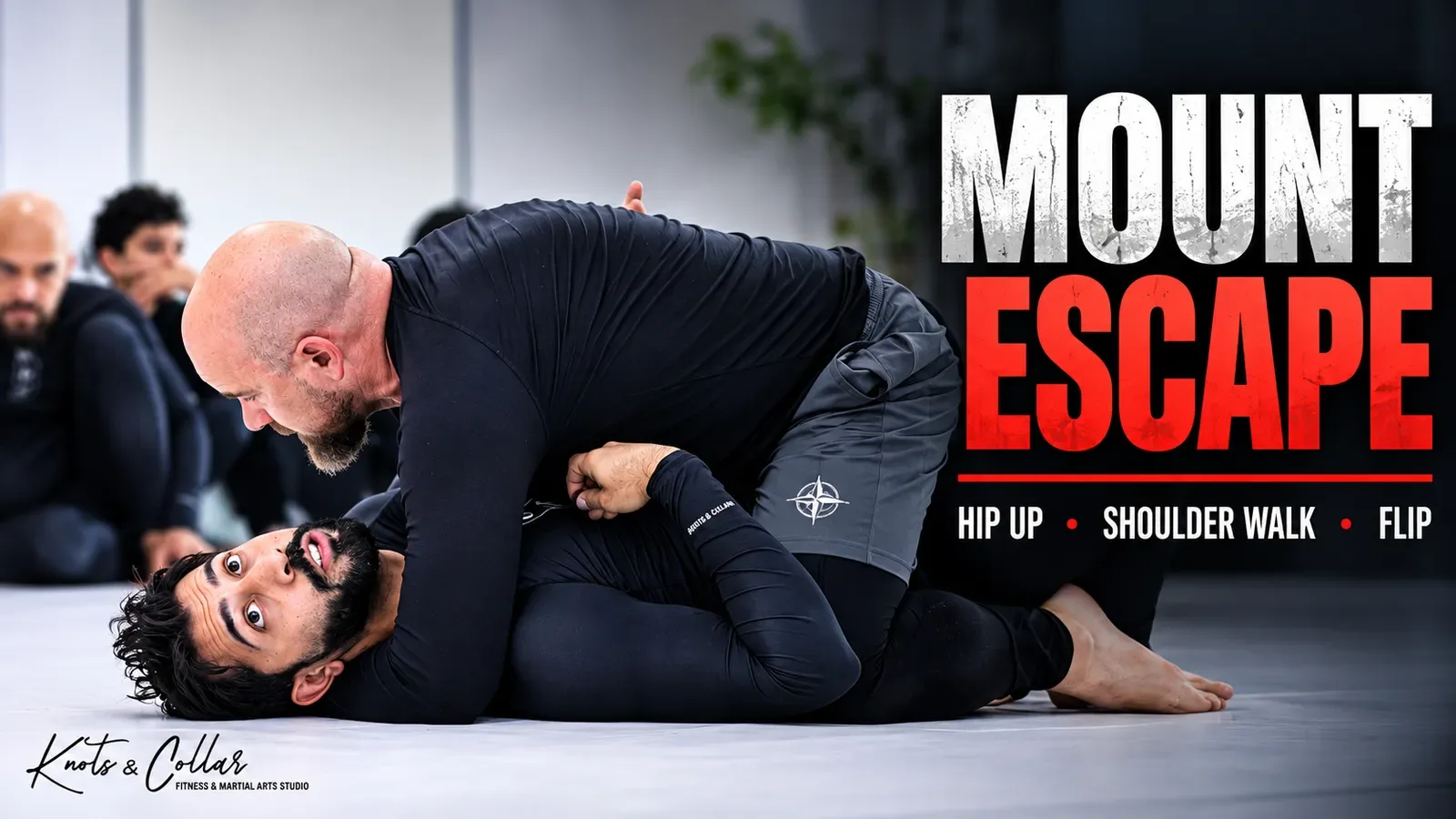
Three scenarios: ear to ear, head up, head away
To prove the rule, the bottom person does exactly the same escape while only the top person changes:
- Ear to ear. Easy.
- Head up. Still works, but harder.
- Head away, favouring the other arm. You have the grip and you know the process, and it still doesn’t work — and now you are more tired.
Same technique, three different results. The only thing that changed was the timing.
Why hips up? Strikes, base and the 12 o’clock
This is the theory part of the class, and it is worth hearing in full in the video.
To strike, the person on top has to take a hand off the mat, which puts their weight onto their other limbs, and especially onto their knees. When you keep your hips up, their knees barely touch the ground, so they cannot take a hand away without losing their balance. “If I’m not lifting this, then I’m safe from knockout strikes.” The same goes for armbars and any other attack where their hands have to leave the mat. That is why this escape matters well beyond the competition mat — our honest look at BJJ for self-defence makes the same point about position before technique.
The 12 o’clock matters for the same reason. If you look sideways, say towards the bags, you are trying to throw them that way, and they can still post a knee. If you look at 12, there is no hand there and no leg there. And if your partner keeps their feet wide, there is no closed guard waiting for you either.
Requirement, process, timing
Professor Binish sums the escape up in three parts:
- Requirement: capture the base. Trap the arm on the side you are escaping to. Without that, there is no escape.
- Process: hip up, shoulder walk, look at 12, kick, flip, sprawl. It never changes. “Like you write on the paper, you go in the same sequence.”
- Timing: their head position. “You can be wrong with everything, you cannot be wrong with this.”
You learn it 1-2-3, but you apply it 3-2-1: first read where their head is, then capture the arm on that side, then run the process.
He also covers the version where the top person has a head control on one side and a forearm or a palm on the other. When the arm is posted on the palm, slap it away in the direction the fingers point and swim under it in the same motion, then finish on the side where the head is.
The Ezekiel and the neck hug
Against the neck hug, where the top person drives a fist into your neck, the hip up does the work. With your hips up they can’t comfortably take that arm away; if they do, they fall. As they move, you pummel, capture the arm and finish the process.
Against the Ezekiel, keep your hips up, wait for them to get heavy, and capture the arm. And if halfway through the escape they post and their head goes the other way, don’t force it. The timing isn’t yours any more. “Timing is always in reference to each other: his head, my head.” If their head slips back under, the timing is yours again: go flat and flip.
The habit he wants from everyone: the moment they mount, hip up, shoulder walk. “That will keep you safe. Even if you can’t escape, you will buy a lot of time. You can breathe well, and there are no attacks on you.”
The paper cutter choke: wrist or elbow
In the Gi, the paper cutter (or bread cutter) choke drives a forearm across your neck. Fighting it strength against strength is a losing game: gravity is on their side. Professor Binish’s rule:
If the wrist is strong, kill the elbow. If the elbow is strong, mess up the wrist.
When there is space, keep your forearm in and fight the wrist. When they have locked it in and the space is gone, push the elbow up instead. It buys you one more second — “no guarantee, but at least you are in a fight.” If you train in both, our Gi vs No-Gi guide covers what changes when the jacket comes off.
Why we don’t trap the foot
Most people first learn the mount escape as the bridge and roll (the upa): trap the arm, trap the foot. Here the foot isn’t trapped, and the reason is simple. The point of trapping the foot is to stop your partner stepping out to post. But the next thing you do is hip up, and the moment you bridge you open the space between your heel and your backside anyway. “So then why put extra effort? Why have one extra step?”
The arm trap matters more, and the detail is how you hold it. If you only hold the collar or the hair, the elbow stays free, and that is where escapes usually fail. Don’t take an underhook yourself, either; it puts your own shoulder in a bad spot. Instead, stretch your arm and keep their elbow pinned next to your pocket. If they try to pull it out, grab the tricep like a shotgun and get stickier the harder they pull.
Grapevines: flip over, don’t roll
When the top person hooks their legs inside yours (grapevines), it is tempting to fight the legs. You don’t need to. The process was built so the leg hooks don’t bother you: hip up, shoulder walk, capture the arm, and then flip over instead of rolling. A roll balances you on a small base, and that is where it fails. The flip spreads you across a much bigger surface, and the grapevines just come with you.
When you are already late
The class closes on the scenario everyone actually ends up in: your partner has already walked an arm over, your shoulder is flat, you are behind. You can still recover. Hip up, shoulder walk, fingers safe, and you are back where the lesson started. “Hips down, shoulder down, and technically you’re losing even worse.”
Then the team rolls, and the video finishes on the live rounds. A movement you have only drilled is one you will not find when somebody heavy is sitting on you, which is why our note on drilling versus rolling matters here. Once you are out from under, the back mount escape and side control escapes classes cover the positions that usually come next, and escaping bad positions puts them all in one place. The mount roadmap maps the whole position, top and bottom.
How to drill it this week
- Solo, every day: hip up and hold, a few shoulder walks, kick, flip. Five to the left, five to the right.
- With a partner, no resistance: double unders, peel the arm, hips up, shoulder walk to ear to ear, look at 12, flip.
- The three scenarios: let your partner choose ear to ear, head up or head away, and only escape when the head is on your side.
- Add the attacks: the neck hug, the Ezekiel, grapevines — same process each time.
Top person: palm up on the shoulder. Either of you can tap or call stop at any point. New to grappling without the jacket? Our No-Gi jiu-jitsu beginner’s guide is the place to start.
Where this class happens
We train No-Gi and Gi through the week at our studio in Defence Colony. If you are choosing where to start, our guide to choosing a BJJ academy in India sets out what to look for on a mat before you sign anything — and then come and stand on ours.
Train with us
We teach Brazilian Jiu-Jitsu, No-Gi and Gi, at Knots & Collar in Defence Colony, New Delhi, seven days a week, for complete beginners and experienced grapplers alike. See the class schedule, book a free trial class, or message us on WhatsApp. Hindi mein baat karni ho? WhatsApp par message kijiye, hum aapko class ke baare mein sab bata denge. For the wider picture of the sport here, read BJJ in India: the complete guide.
FAQs
How do you escape the mount in No-Gi BJJ?
Put your hips up and shoulder walk until your head is level with your partner’s, ear to ear. Capture the arm on the side their head is on, look at 12 o’clock, kick that foot sideways and flip, pulling the back leg through. Stay low after the flip instead of rushing to your knees, or they can close their guard on you.
Why should you keep your hips up under mount?
With your hips up, the top person’s knees barely touch the mat, so most of their weight is on their hands. To strike or attack an arm they have to take a hand away, and they cannot do that without losing their balance. Even before you escape, hips up keeps you safe: you can breathe, you buy time, and there are no attacks on you.
What does ‘look at 12’ mean in the mount escape?
Imagine a wall clock above your head. Wherever you look is where you go, so look at 12 o’clock, diagonally past your partner’s head. Looking sideways tries to throw them where they can still post a knee; at 12 there is no hand and no leg to stop you.
Why does this mount escape not trap the foot like the bridge and roll?
Trapping the foot is meant to stop your partner stepping out to post, but the moment you hip up you open the space between your heel and your backside anyway. So the step is extra effort for nothing. The arm trap matters far more: keep their elbow pinned next to your pocket, and if they pull it, grab the tricep and get stickier.
How do you defend the Ezekiel choke and the paper cutter from mount?
Against the Ezekiel, keep your hips up, wait for them to get heavy and capture the arm, then run the escape when their head is on your side. Against the paper cutter, do not fight strength against strength: if the wrist is strong, push the elbow up; if the elbow is strong, fight the wrist.
What if my partner hooks my legs with grapevines?
Do not fight the legs. Hip up, shoulder walk, capture the arm and then flip over instead of rolling. A roll balances you on a small base and fails there; a flip spreads you across a much bigger surface, and the grapevines come with you.
Does this mount escape work in the Gi?
Yes. This was a No-Gi class, and the process is the same in the Gi: hips up, shoulder walk, capture the arm, read the head, flip. The Gi adds collar chokes such as the paper cutter, which is why the class covers the wrist-or-elbow rule for it.
Kindness Over Toughness.