
Submission grappling vs No-Gi BJJ: what is the difference?

Search for No-Gi classes in India and you will find the words “submission grappling” next to them, sometimes as if they were the same thing and sometimes as if they were rivals. On the mat they look almost identical: two people in rash guards and spats, no strikes, trying to control each other until one taps. The differences are real, though, and they are worth knowing before you choose a class or sign up for your first event.

The short answer
Submission grappling is the wider family: any grappling without strikes where the aim is a submission, usually trained without a gi. It draws on Brazilian Jiu-Jitsu, wrestling, judo, sambo and catch wrestling, and different rooms mix them in different amounts.
No-Gi BJJ is one member of that family: Brazilian Jiu-Jitsu trained in a rash guard, spats and shorts. It keeps everything that makes BJJ what it is, the positions, the order they are learnt in, the belt system and the idea of control before submission, and takes away the collar and sleeve grips.
So most No-Gi BJJ is submission grappling, but not all submission grappling is taught as BJJ. If you want the fuller picture of No-Gi on its own, our complete guide to No-Gi jiu-jitsu covers it from the start.
Where they are the same
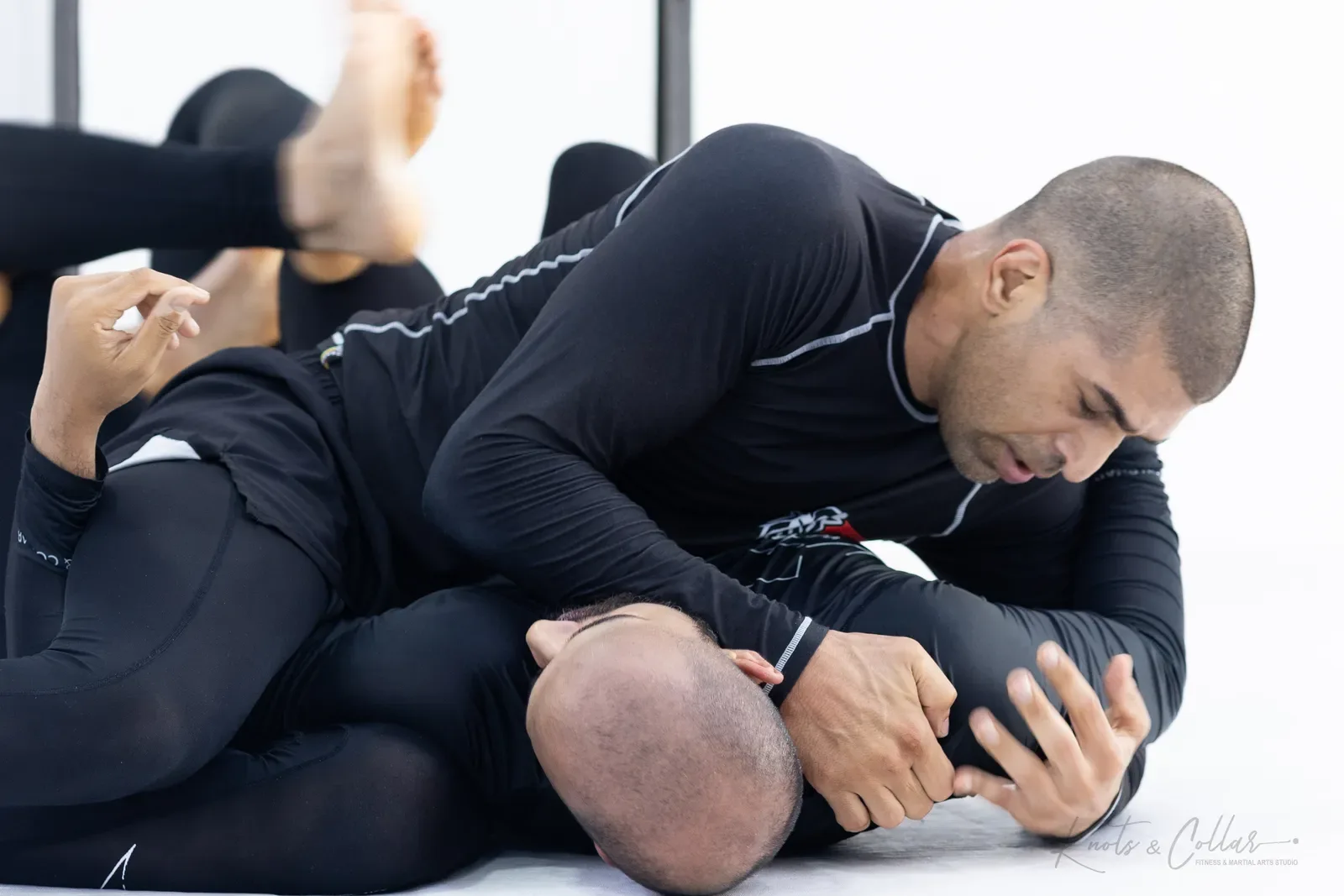
Put a No-Gi BJJ player and a submission grappler on the same mat and they will understand each other within a minute. Both work from the same map:
- The positions: guard, half guard, side control, mount and the back.
- The submissions: chokes such as the rear naked choke and the triangle, and joint locks on the arms and legs.
- The grips: with no cloth to hold, both rely on wrists, underhooks, overhooks, the head and the legs.
- The kit: a rash guard, spats and shorts. See what to wear to your first class.
Where they differ
1. Ranks
No-Gi BJJ uses the BJJ belt system. Your belt is the same whether you train in the gi or out of it, and the hours you spend in No-Gi count towards it. Many submission grappling and wrestling-based rooms have no belts at all; progress is measured by who you can handle in a round and by results in competition. Neither is wrong, but a belt gives a beginner a clear sense of where they are. Our guide to the BJJ belt system explains how that works.
2. Rules
The rules shape the game more than anything else, and this is where the two names really part ways.
- IBJJF No-Gi is BJJ’s own ruleset: points for takedowns, sweeps, passing the guard, mount and taking the back, with advantages and penalties as tie-breaks. Our guide to BJJ points and scoring walks through them.
- ADCC, the Abu Dhabi Combat Club Submission Fighting World Championship, first held in Abu Dhabi in 1998, is the best-known submission grappling event. Points only start to count partway through a match and pulling guard is penalised, so the opening minutes are about wrestling and attacking rather than stalling for an advantage.
- Submission-only events have no points at all. A match ends with a tap or goes to an overtime round.
3. Leg locks
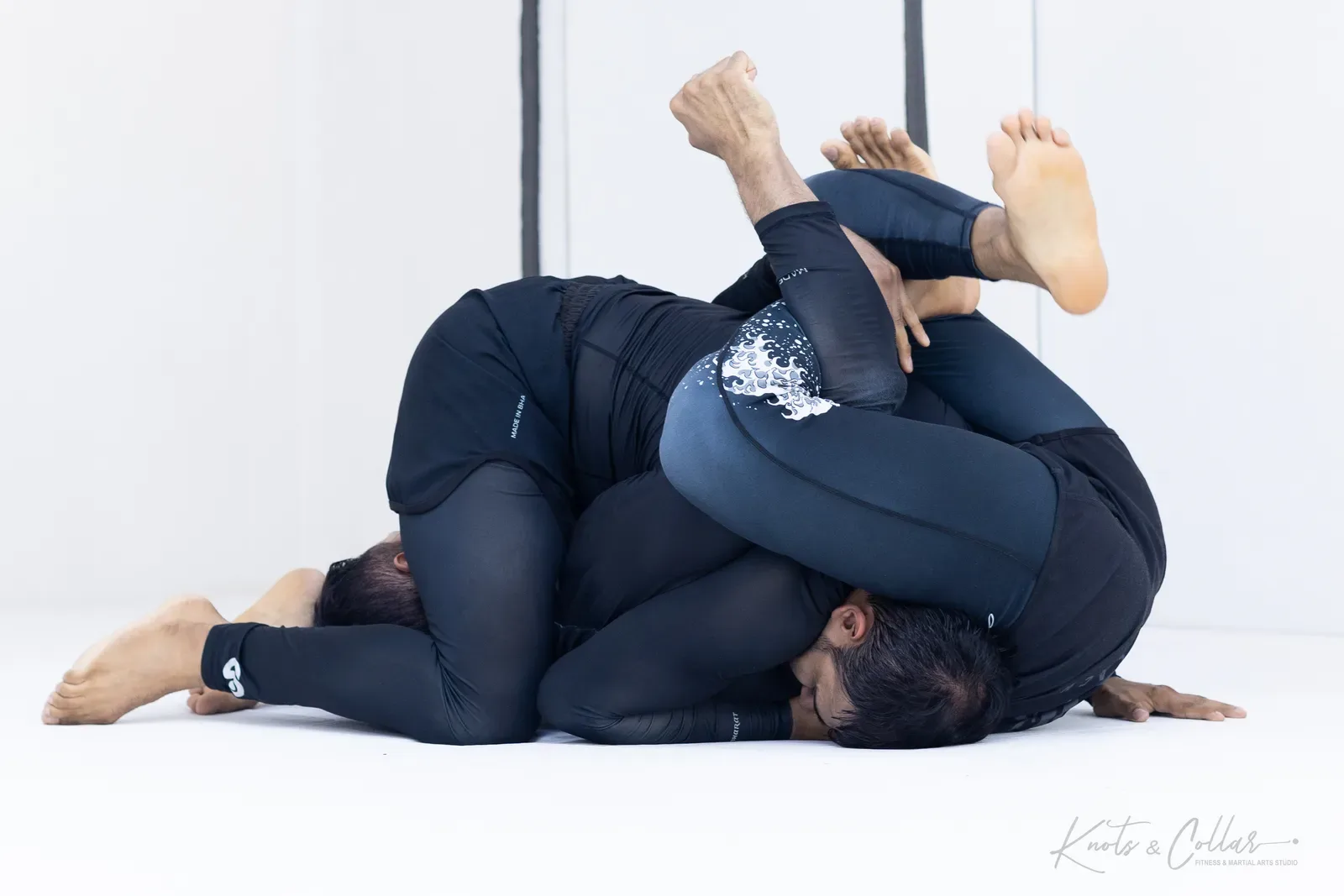
This is the difference people notice first. Under IBJJF rules, heel hooks and knee reaping are allowed in No-Gi only for brown and black belts. Many submission grappling and submission-only events allow heel hooks at every level, so their rooms tend to teach leg entanglements early. Neither approach is reckless when it is taught well; the knee is simply a joint that gives very little warning, so the rule in any room is the same: learn the positions slowly, tap early, and agree before you go for one. Our guide to BJJ leg locks explains the main ones.
4. Wrestling
Because ADCC-style rules reward the person who gets on top, submission grappling rooms often spend more of the class standing. No-Gi BJJ classes start standing too, but more of the time is usually spent on the guard, playing from your back and getting back to your feet. If wrestling is your background, our comparison of BJJ and wrestling shows how the two fit together.
5. How it is taught
A BJJ class, gi or No-Gi, follows a steady order: a position, its escapes, its attacks, then live rounds from that position. That order is why a complete beginner can survive a first roll. Submission grappling classes vary more from room to room, from very BJJ-like to very wrestling-heavy.
Which one should you start with?
If you are new, start where you will be taught the positions before the submissions. Submissions only make sense once you know where you are and how to stay there, and a beginner who learns the heel hook before the guard spends a lot of rounds lost.
That is the case for starting with No-Gi BJJ. You get the structure of BJJ, a belt that tracks your progress, and everything you learn carries over if you later compete under submission grappling rules or put on a gi. Many people in India come to jiu-jitsu through MMA, wrestling or kushti, and No-Gi feels familiar to them from the first class. If you are still deciding between the two uniforms, read gi vs No-Gi for beginners.
Submission grappling and No-Gi in India
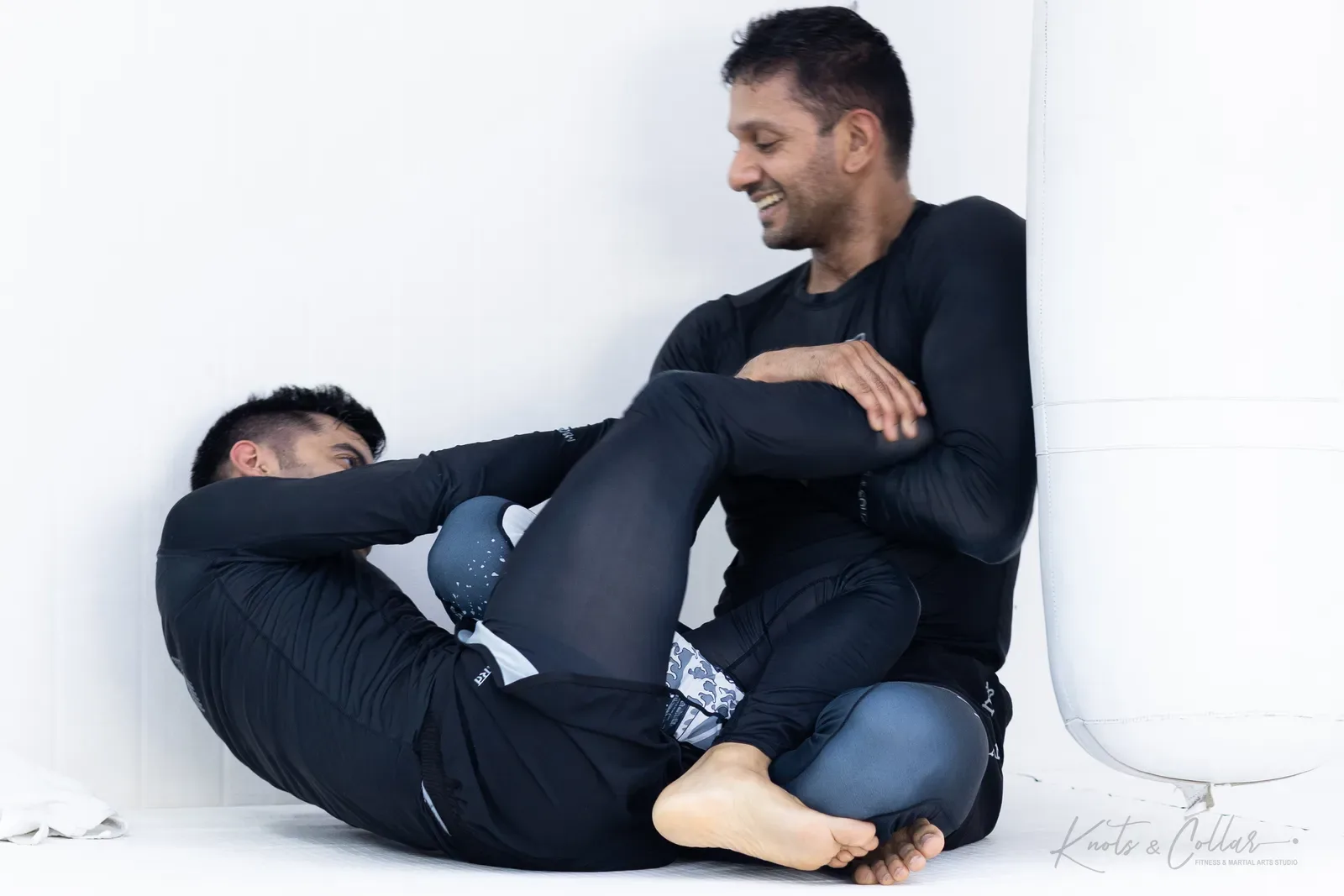
No-Gi is growing quickly in India, and so is interest in submission-only and ADCC-style matches. Competition is still young: events are occasional and rules differ from one to the next, so always read the ruleset before you enter, especially the leg-lock rules for your level. ABJJF India, which is building the national federation for Brazilian Jiu-Jitsu in India, is working on consistent rules, verified ranks and beginner-friendly divisions. For the wider picture, see our guide to BJJ competitions in India and No-Gi BJJ in India.
No-Gi at Knots & Collar
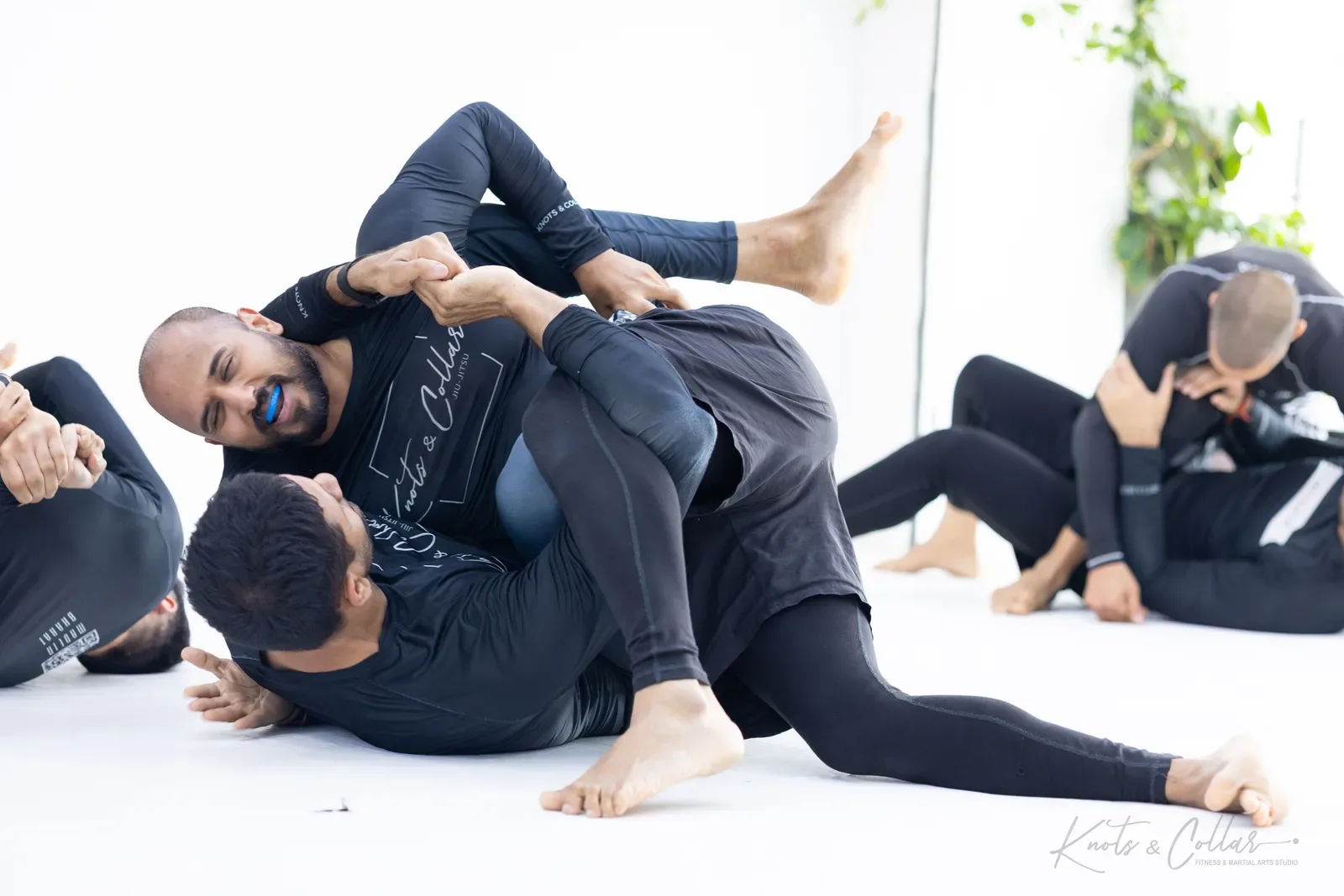
At the studio in Defence Colony, No-Gi is taught as Brazilian Jiu-Jitsu: positions first, then escapes, then attacks, then rounds. It runs four times a week, Wednesday 7pm, Thursday 6:30am, and Saturday 8am and 9am, with open rolling after the Saturday class. The Saturday 8am class, Essentials 1.0, is the easiest place to start. Wear a rash guard, spats and shorts. See No-Gi BJJ in Delhi for what a session looks like.
The rounds are hard and the room is kind. Partners tap early, let go straight away, and look after whoever is newest. That is what Kindness Over Toughness means on a No-Gi night.
FAQs
Is submission grappling the same as No-Gi BJJ?
They overlap almost completely on the mat. Submission grappling is the wider term for any grappling without strikes where you win by making your partner tap, usually without a gi. No-Gi BJJ is Brazilian Jiu-Jitsu trained in a rash guard and spats, with the same positions, ranks and teaching method as BJJ in the gi. Most No-Gi BJJ is submission grappling; not all submission grappling is taught as BJJ.
Do you get belts in submission grappling?
Usually not. Many submission grappling and wrestling-based rooms have no belt system. In No-Gi BJJ your rank is your BJJ belt, the same one you would wear in the gi, so time spent training No-Gi counts towards your belt.
What is ADCC?
ADCC is the Abu Dhabi Combat Club Submission Fighting World Championship, first held in Abu Dhabi in 1998. It is the best-known submission grappling event in the world. Its rules reward attacking: points only start to count partway through a match, and pulling guard is penalised.
Are leg locks allowed in No-Gi BJJ?
It depends on the rules. Under IBJJF rules, heel hooks and knee reaping are allowed in No-Gi only for brown and black belts. Many submission grappling and submission-only events allow heel hooks at every level. In training, always agree with your coach and partner before going for a leg lock.
Should a beginner start with submission grappling or No-Gi BJJ?
Start with a class that teaches positions before submissions. A No-Gi BJJ class gives you that structure: guard, passing, mount, side control and the back, and how to escape each, with a belt that tracks your progress. The submissions make sense once you know where you are.
Where can I train No-Gi or submission grappling in Delhi?
Knots & Collar in Defence Colony, New Delhi, runs No-Gi BJJ four times a week: Wednesday 7pm, Thursday 6:30am, and Saturday 8am and 9am, with open rolling after the Saturday class. The first class is free.
Book a free No-Gi class at Knots & Collar, Defence Colony. Kindness Over Toughness.