
Professor Bek of Checkmat Kazakhstan at Knots & Collar: Takedowns, Guard Sweeps and How to Train
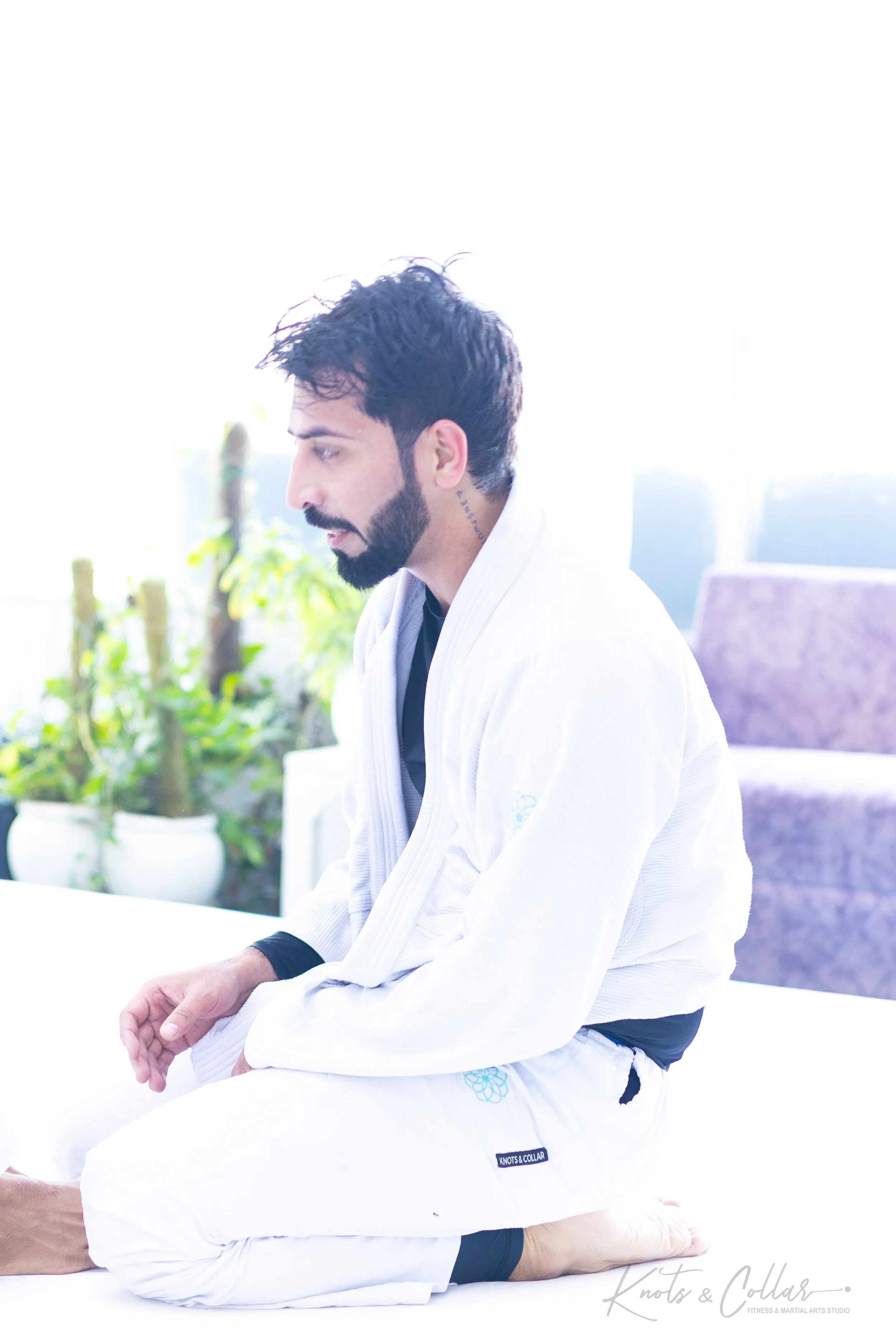
Professor Bek opened the first jiu-jitsu gym in Kazakhstan. Today, in his words, you might not find judo in every city there — but you will find jiu-jitsu. He spent a day on our mats in New Delhi, and this is what he taught.
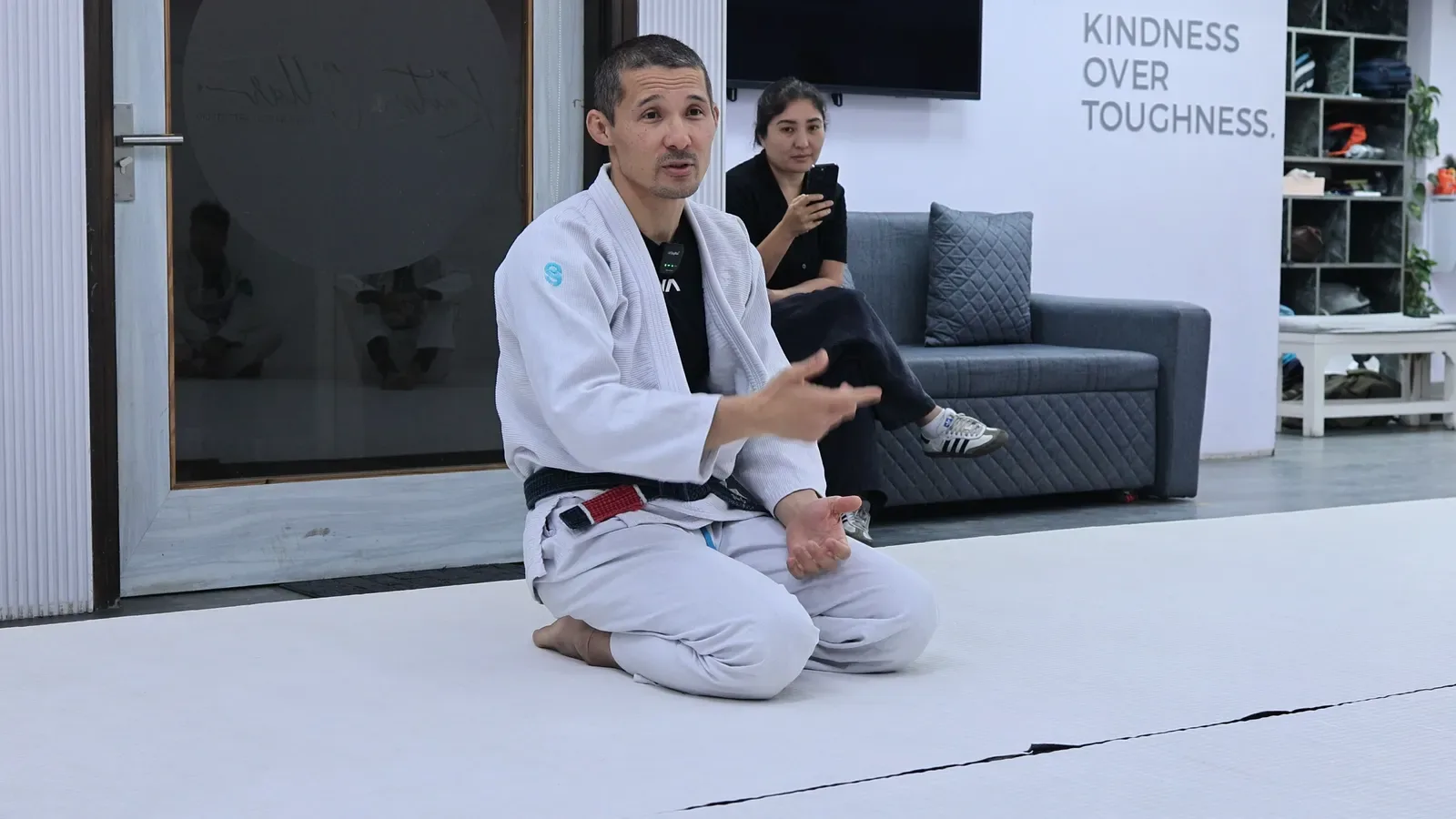
Professor Bek is the founder and head coach of Checkmat Kazakhstan, with 18 years of Brazilian Jiu-Jitsu behind him. His seminar at Knots & Collar covered the whole journey of a roll — the takedown, the closed guard, the open guard, the half guard, a finish from mount — and then something most seminars leave out: how to train so that any of it actually sticks.
For a studio working to grow Brazilian Jiu-Jitsu in India, his story is worth hearing on its own. Kazakhstan went from one gym to jiu-jitsu in every city within a generation of students, and he believes India can follow. The full seminar is below; the notes underneath follow it chapter by chapter.
Seminar chapters
- 0:00 Intro
- 0:19 Professor Bek: in this seminar
- 0:40 Meet Professor Bek: 18 years of jiu-jitsu, founder of Checkmat Kazakhstan
- 3:36 Standing: prepare the takedown, find his rhythm
- 6:02 Closed guard: stand up and open it
- 8:43 Open guard: the seated butterfly sweep (2 vs 3 points)
- 11:22 Half guard sweep from the bottom
- 12:55 Cross choke from mount
- 14:51 How to train: one position a week, positional sparring
- 18:09 Final words: trade-offs and jiu-jitsu in India
Who is Professor Bek?
The seminar opens with an old friendship — eleven years, as the two of them work out on camera. Professor Bek's own clock runs longer. "I do 18," he says: eighteen years of jiu-jitsu, and wrestling in school before that.
Jiu-jitsu found him almost by accident. He went to the United States to study, wanted to keep wrestling, and was told that was not possible at university. What they could offer was a small student club — and it happened to be jiu-jitsu. "So I said, jiu-jitsu, nice, let's go." He trained at the university, then in New York, and trained — and still trains — under Leo Vieira of Checkmat in Los Angeles.
Back home he founded Checkmat Kazakhstan, where he is head coach. The academy trains Gi and No-Gi in equal measure, fifty-fifty, and he describes the students who only ever want one or the other with affectionate humour: in every tradition, he says, you have your purists.
How jiu-jitsu grew in Kazakhstan
"I brought jiu-jitsu in Kazakhstan," he says, plainly. His was the first gym, and it grew to 120 students. Then something he did not plan for happened: people saw that a jiu-jitsu academy could be a real livelihood. Some of his own students opened academies; others hired coaches and opened theirs.
The result, in a country of around 20 million people, is jiu-jitsu in every city. "Maybe you could not find judo, but you can find jiu-jitsu." He is candid that he never expected it.
That is a story with a clear lesson for anyone building the sport in India. It did not grow because of one gym. It grew because students became coaches, and coaches built communities of their own. If you are curious where the sport stands here, our guides to whether BJJ is growing in India and building the jiu-jitsu community in India pick up the same thread.
Standing: prepare, cook, then eat
Professor Bek does not attack a takedown directly. He shows a leg, touches without grabbing, and watches his partner sprawl. Then he does it again — one, two — and only then goes for the leg he actually wanted.
His way of putting it is the line everybody remembered afterwards: "You prepare, you cook, then you eat." Going straight for the finish works on someone brand new. Against anybody with experience, the set-up is the technique.
Jiu-jitsu is a dance where nobody helps you
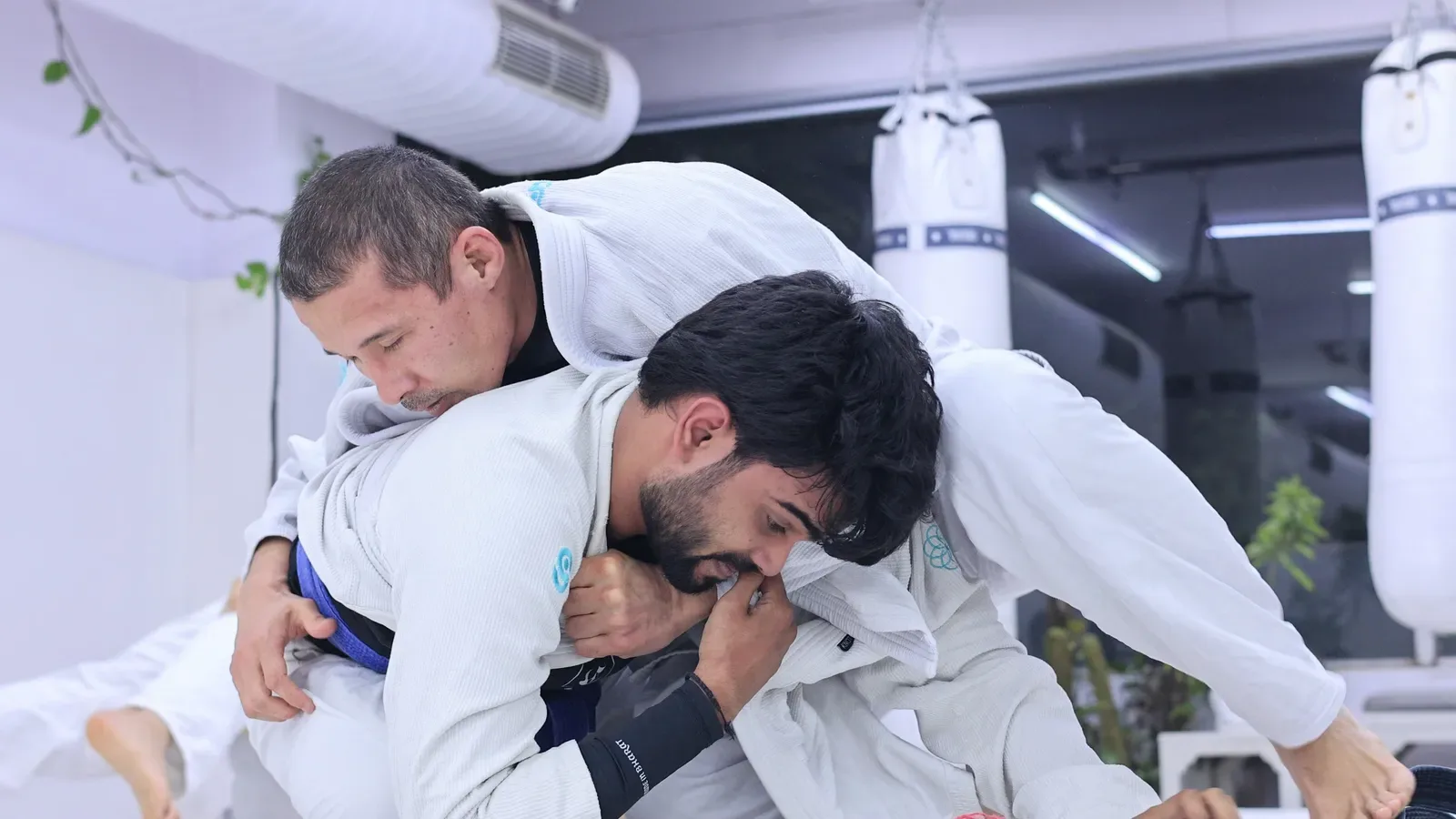
He compares jiu-jitsu to dancing, with one difference. When people dance, they help each other. "In jiu-jitsu we dance, but we try not to help each other." Your partner tries to break your rhythm; you try to break theirs.
A round starts as a dialogue. In training, it should stay one. In competition, he wants to change it into a monologue — "when I speak, he just shuts up." To get there, he first has to feel his partner's rhythm: go, go, reset, and on the next wave the timing is his. He likens it to surfing — getting into the other person's wave — and at the key moment he stops and sweeps the foot, with a long, cutting motion of the leg rather than a low kick.
If takedowns are new to you, our beginner's guide to BJJ takedowns covers the fundamentals this builds on, and BJJ and wrestling explains how the two arts meet on the feet.
Closed guard: stand up and open it
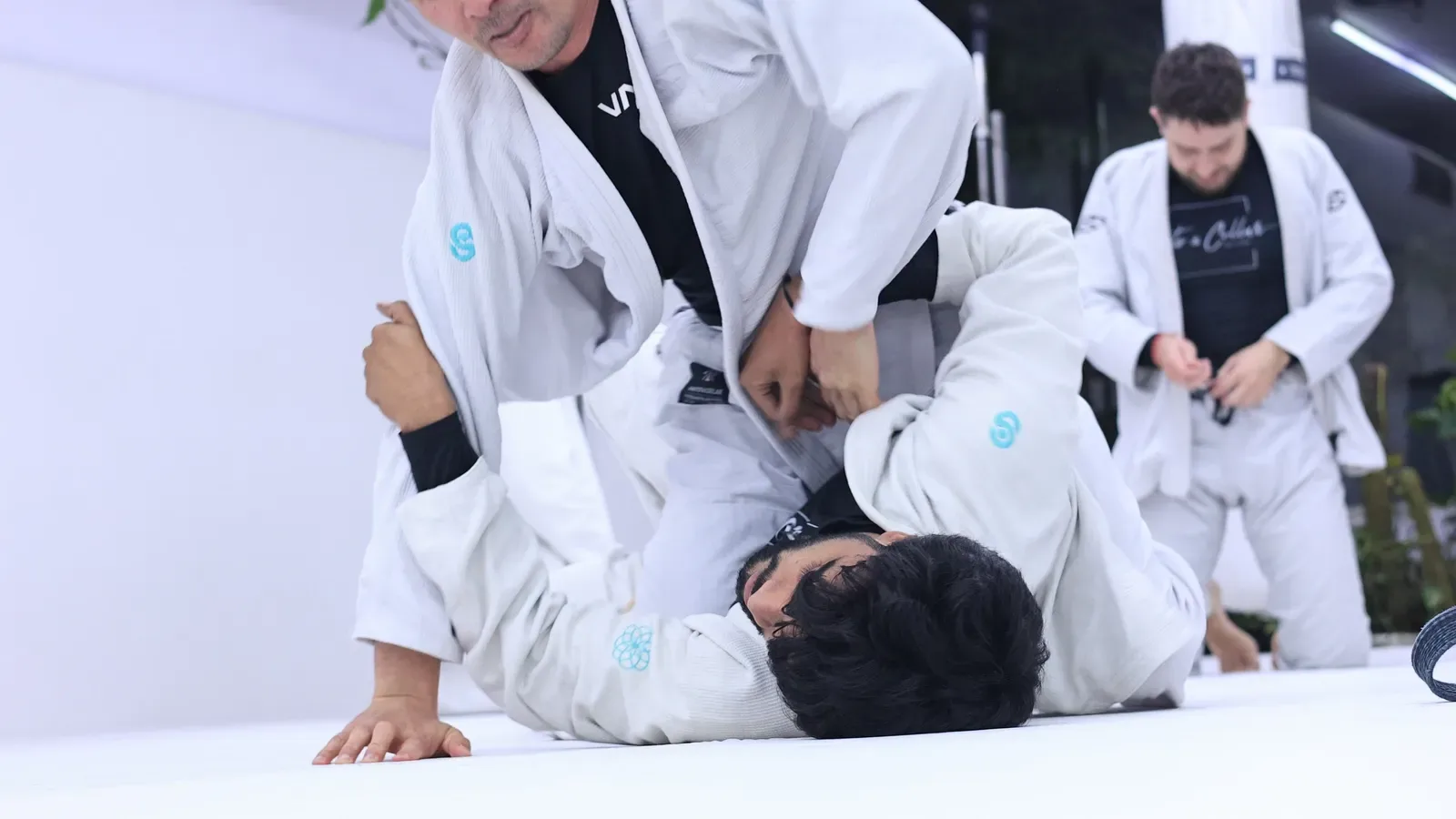
"Let's start with the basics," he says — and the basics are how to get out of the closed guard. Staying on your knees inside it is dangerous. The better choice is to stand, but the moment you try, your partner shakes you like an earthquake. So the order matters:
- Immobilise the hands. Stop them gripping your collar and sleeves. Take a tight collar grip and press their hands down towards their armpits.
- Check the elbows. If their elbows are above their shoulders, they are neutralised. If the elbows drop below the shoulders, they can work.
- Put your weight on them to stand. With your weight over your partner, your legs are light enough to come up.
- Bring your knees together. Knees closer together, feet outside. He points to the back of a Mercedes: the wheels tilt slightly, and that is what keeps the car balanced. Knees wide and straight, and your partner can play with your balance.
- Straighten your back — and watch your nose. His balance indicator is simple. Nose pointing down means you are off balance; nose facing forward means you are in balance.
- Open the lock with your hips. Turn their knee and push your hips forward together. The hips are your strongest part, and the lock pops open.
For the bottom player's side of these positions, see BJJ guard types explained, and the closed guard roadmap shows where this sits among the other closed guard skills.
Open guard: the seated butterfly sweep
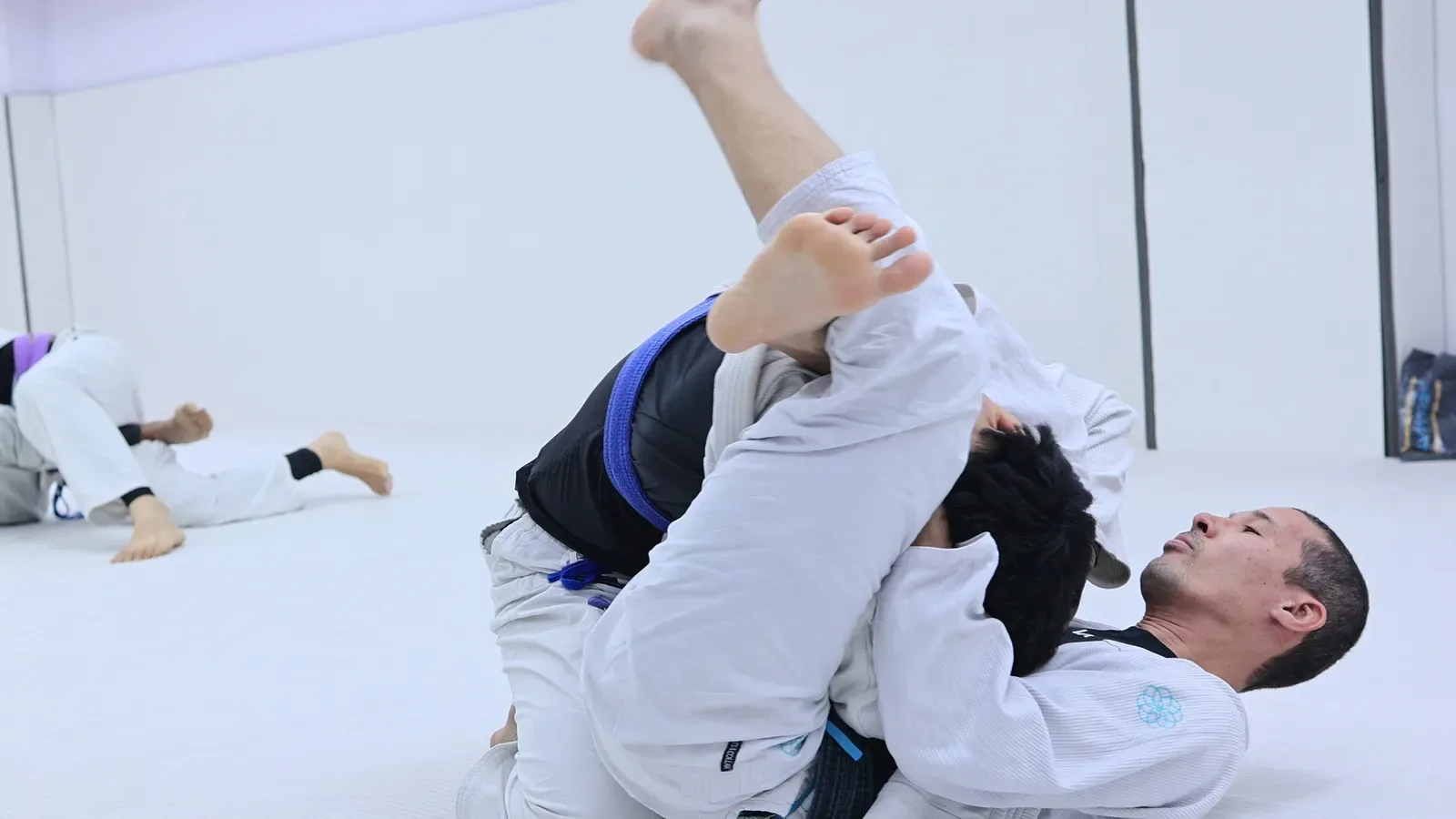
Before the sweep itself comes one small idea that changes how you sit. Professor Bek grades positions. Seated in open guard, you are strong. Lying flat on your back, you are weaker. So once you are seated, stay seated — "if I go supine, I make him a favour to pass."
From that seated position, the butterfly sweep:
- Get the underhook. Hold the belt, the jacket or the trousers — or, without a Gi, just the underhook itself.
- Neutralise the other hand at the wrist. Grip the wrist, or take three fingers into the sleeve.
- Bring your hips under their hips. This is what gives you control of their balance and weight; with your hips out in front, the sweep is easy to counter.
- Ground one leg on the mat and go sideways. Do not lift their whole weight onto yourself. Accompany it to your side and use their momentum. Lifting is hard on your knees, costs energy, and — as he puts it — is not good for your health.
Two points or three: the three-second pause
Then a scoring detail that wins matches. A sweep is one action and a guard pass is another, but only if you hold the position for three seconds in between. Sweep and run straight through to side control, and it counts as the first action only — a sweep, two points. Sweep, stay there for three seconds, then pass, and you are awarded the pass as well.
If the points system is new to you, our guide to BJJ points and scoring explains how sweeps, passes and positions are scored, and the butterfly guard roadmap lays out the skills around this sweep.
Half guard sweep from the bottom
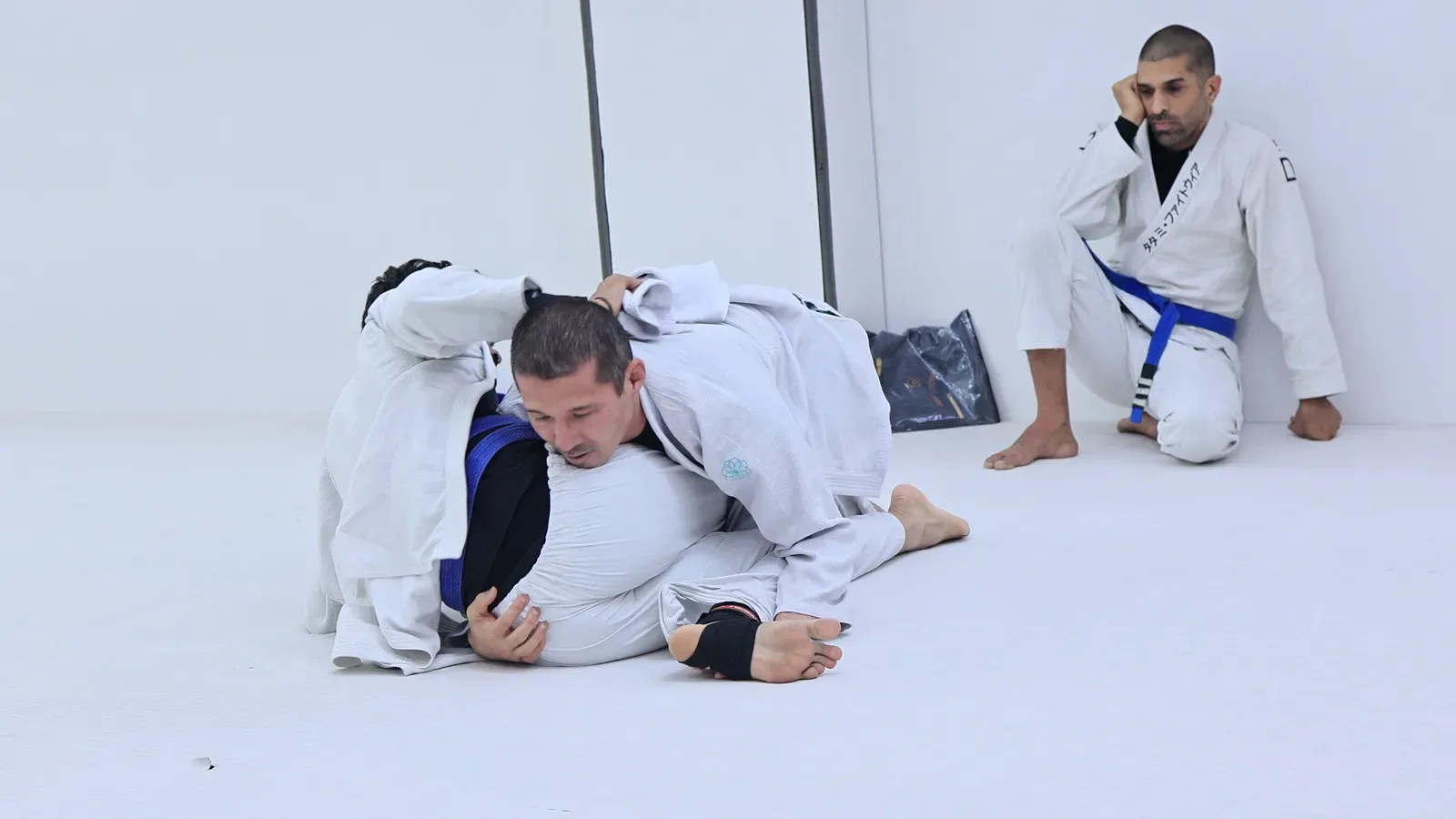
Sometimes you lose the fight for the underhook — Professor Bek tries never to give it up, but it happens. Your partner has the underhook and is driving forward with a lot of pressure. That pressure is exactly what you use.
- Take a grip. Their belt, their trousers or their jacket.
- Hook with your toes and close off their knee with your other leg.
- Close their first post. Bring your elbow in against their elbow, tight to your ribs.
- Close their second post. Their knee is the other post; close it with your leg.
- Use their forward pressure. As they push, turn with your hips, and they go over.
Seen from the other side, our half guard pressure pass lesson shows what the top player is trying to do, and the half guard roadmap connects the two.
Cross choke from mount
The finish is a cross choke, and the detail is all in the fit.
- First hand in, knuckles to the mat. Your knuckles go down to the tatami, so the hand sits deep.
- Fit it like Lego. There is a particular place beside the neck where the hand clicks in. No slack in the jacket, nothing loose.
- Second hand in, knuckles down. Then post your forehead on the mat as a base.
- Use the blade of the wrist, not the flat. He compares it to cutting bread: the thin edge of the knife goes through, the wide side does not.
- Choke with your whole body. Not only the hands — use your hips and the muscles of your back.
Then, watching a partner practise, he smiles: "You are too polite." His less polite version: thumbs in, bring the elbow over, move the cheek aside, post the forehead, and draw your elbows towards your ribs. It is a joke with a serious point — a choke needs to be precise and committed — and it sits comfortably with how we train: partners tap early, and the person applying it lets go the moment they do.
Our guide to BJJ submissions for beginners explains how chokes work and why tapping is part of the art.
How to train: one position a week
This was the part of the seminar people talked about most afterwards. At Checkmat Kazakhstan, training runs on positional sparring. If it is open guard week, rounds start only in open guard. Half guard week, only half guard. Free rolls happen rarely — two or three times a week.
His reason is time. In a five-minute free roll, partners can spend fifteen, twenty, fifty seconds circling before anything happens. Start a round in closed guard and the work begins immediately. Over weeks, that adds up to far deeper knowledge of each position, and overall progress comes faster.
Inside positional rounds there are specifics too: a round where the only mission is the berimbolo, or only the 50-50, or only the spider web. Why go that narrow? Because surface knowledge is not enough if you want to win.
"I could not be a professional in construction, in automobiles, in AI, in finance and everything," he says. "I have to have my specifics — two, three fields that I am expert in." When he rolls with someone, he brings them into those fields. That is what a game is, and the only way to build one is to work specifically on it.
We look at the balance between the two ways of training in drilling versus rolling, and at building your own specifics in how to build your BJJ game.
The technique that calls you
How do you choose those two or three fields? Professor Bek's answer is gentle: let the technique choose you. You learn, say, the Kimura sweep from closed guard in class, and something about it feels close. The next time you roll, you find yourself looking for it. "That means the technique calls you."
Build your game around it. Eventually your training partners will know it is coming — and then the work moves to the set-up. How do you hide the sweep? How does the entry change when they are expecting it? "But the technique, the core, will be the same. That's the logic."
Final words: trade-offs, and jiu-jitsu in India
Eleven years of friendship, he says, passed quickly. Jiu-jitsu takes something from your health over that time, and he does not pretend otherwise. It is a trade-off: give something, and in return you get the intellectual pleasure of the game.
On India, he is optimistic. The country has a long history of martial arts, a history of freestyle wrestling and of boxing with Olympic medallists, and "people love to fight here." He thinks jiu-jitsu will grow gradually — and that it puts a responsibility on the people who already train. Someone sees that you train and love jiu-jitsu, and they try it. They get hooked, and they bring someone else. At his academy, parents in their forties train while their seventeen- and eighteen-year-old children compete.
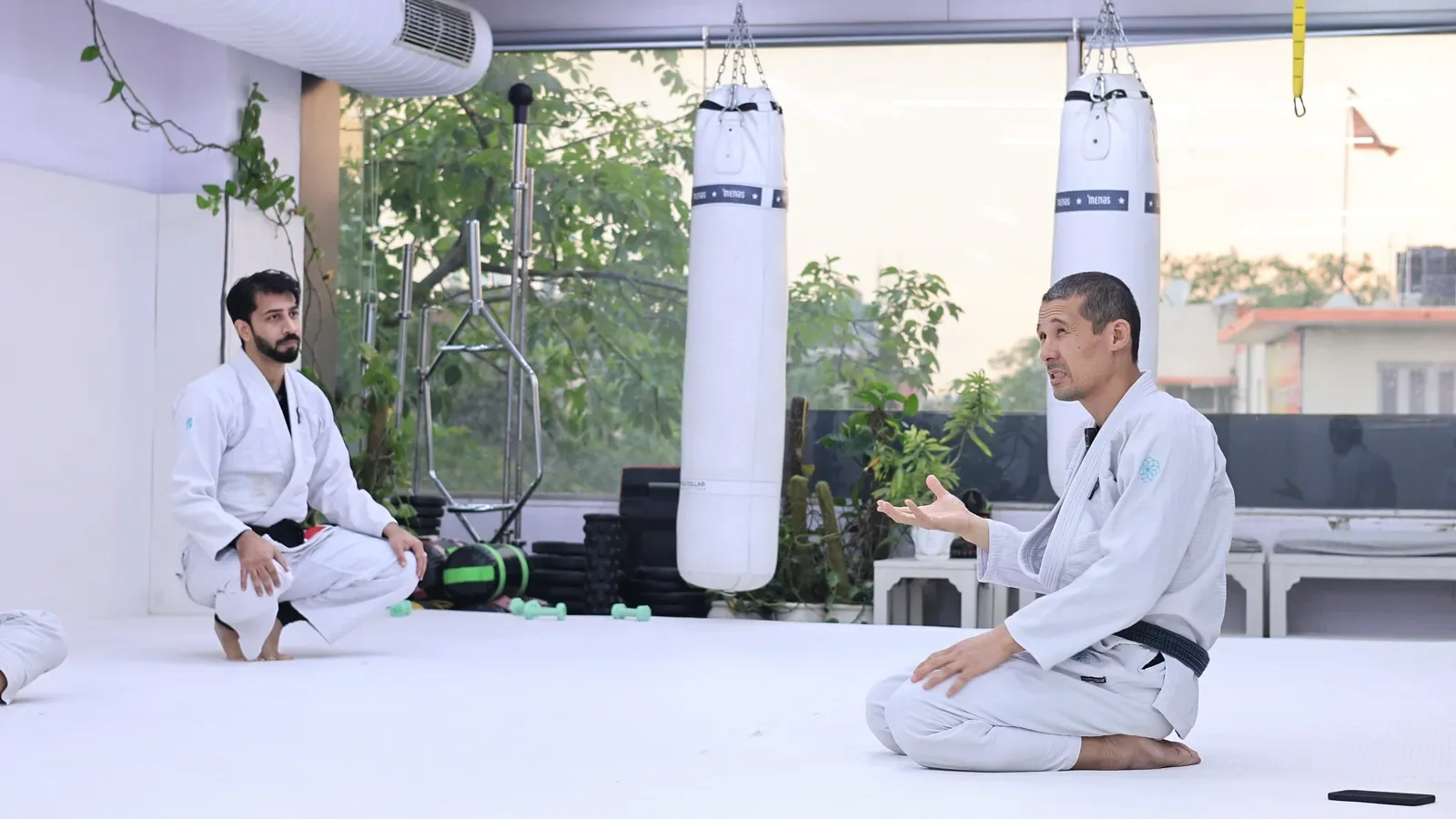
And his closing line got the biggest laugh of the day. He loves everything about jiu-jitsu, "except bills — and some dramas." His advice: "Let's not spend energy for dramas. Let's develop techniques."
For the bigger picture of the sport here — where to train, how belts work and how to start — read BJJ in India: the complete guide.
Seminars at Knots & Collar
Visiting instructors bring a different eye to the same positions we drill every week, and our students take those details back into every class. Upcoming seminars and past visits are on our seminars page.
FAQs
Who is Professor Bek?
Professor Bek is the founder and head coach of Checkmat Kazakhstan. He has trained Brazilian Jiu-Jitsu for 18 years, after wrestling in school, and still trains under Leo Vieira of Checkmat. He opened the first jiu-jitsu gym in Kazakhstan and taught this seminar at Knots & Collar in New Delhi.
What did Professor Bek teach at the Knots & Collar seminar?
Setting up a takedown by reading your partner's rhythm, standing up to open the closed guard, the seated butterfly sweep, a half guard sweep from the bottom, the cross choke from mount, and how to structure training around positional sparring.
How did jiu-jitsu grow in Kazakhstan?
In Professor Bek's telling, he opened the first gym and had 120 students. Some of those students went on to open academies of their own, others hired coaches, and today, in a country of around 20 million people, you can find jiu-jitsu in every city.
What is positional sparring in BJJ?
Positional sparring means starting a round from one agreed position — closed guard, half guard, open guard — and working only that position. Professor Bek's students spend a week on one position and free roll only two or three times a week, because every second of a positional round is spent working rather than circling.
Why pause for three seconds after a sweep?
Under the points system Professor Bek described, a sweep and a guard pass are separate actions only if the position is held for three seconds between them. Sweep and pass straight through and only the sweep's two points count; sweep, hold for three seconds, then pass, and you are awarded the pass as well.
Does Knots & Collar host international BJJ seminars?
Yes. Knots & Collar in Defence Colony, New Delhi hosts visiting instructors from India and abroad, and our seminars page lists what is coming up. Everyone who trains with us, from beginners to experienced grapplers, is welcome to join.
Train with us
We teach Brazilian Jiu-Jitsu in the Gi and No-Gi at Knots & Collar in Defence Colony, New Delhi, seven days a week, for complete beginners and experienced grapplers alike. See the class schedule, or book a free trial class.
Kindness Over Toughness.